Blogpost by Amy Moas - 30 January, 2018
If it seems like we’ve been talking about lawsuits a lot lately, it’s because we have.
Corporate bullies, helped by Donald Trump’s go-to law firm, have filed two massive lawsuits against Greenpeace in the last two years. They aim to silence us, but we are not alone. Many of our allies and other individual activists are fighting meritless lawsuits of their own. These Strategic Lawsuits Against Public Participation (SLAPPs) are not about justice or corporations righting some kind of wrong, but about tying up our resources in hopes that we won’t be able to keep fighting for a green and peaceful future.
Today, we filed a motion to dismiss one of these SLAPPs that should have already gone away for good.
Resolute Forest Hearing in San Francisco 10/10/2017 © George Nikitin / Greenpeace
Participants and activists appear outside a United States District Court - October, 2017
Nearly two years ago, Resolute Forest Products — the largest logging company in Canada — filed a CAD$300 million Racketeer Influenced and Corrupt Organisations Act (RICO) lawsuit against a number of Greenpeace defendants. In case you haven’t heard of RICO, it’s a law designed to prosecute the mafia and stop organised crime (read: nothing to do with preventing peaceful activists from protecting forests).
In response to this baseless lawsuit, thousands of you raised your voices to make it clear that forest defenders everywhere will not be intimidated by corporate bullies that aim to silence us to protect their profits. And we’ve seen important progress.
Three months ago, a US judge threw out Resolute’s lawsuit in its entirety. Furthermore, the judge ordered Resolute to reimburse Greenpeace for our attorney fees under California’s anti-SLAPP law.
But for Resolute, this case has never been about winning; it’s about stopping us from fighting for forests by sucking up precious time and money. The company showed this in November when it filed a repackaged version of its meritless lawsuit. Because of this, we are all back in this fight.
Today, we filed a 40-page brief outlining why this “new” version of Resolute’s lawsuit is the same old story as the case that’s already been dismissed — and why it deserves the same fate.
There is no reason to think this new version of this lawsuit will not die the same death it did originally, but it does mean that forest lovers can’t stop fighting now. Attacks on our right to speak up threaten so much more than just Greenpeace, they threaten countless groups fighting to make the world a better place — including your right to fight for the planet you love. That’s why there are more than 30 organisations gathering in Washington, DC today to fight back against SLAPPs together.
Because each and every SLAPP threatens us all, we must fight each and every one together. Already, your voices have shown Resolute and companies everywhere that the movement for a green and peaceful future is stronger than corporate intimidation. Now it’s time to speak up again and bury this case once and for all — join the fight and stand up to SLAPPs today.
Greenpeace activists in a forest near Werbellinsee in Brandenburg - April, 2017
Amy Moas, PhD is a senior forest campaigner for Greenpeace USA
Thanx Amy Jenny the Crusader
Thursday, February 1, 2018
Tuesday, January 30, 2018
Scott Pruitt is slowly strangling the EPA
The unprecedented regulatory slowdown and rollbacks at the Environmental Protection Agency
The mandate of the head of the Environmental Protection Agency is to protect human health and enforce environmental regulations.
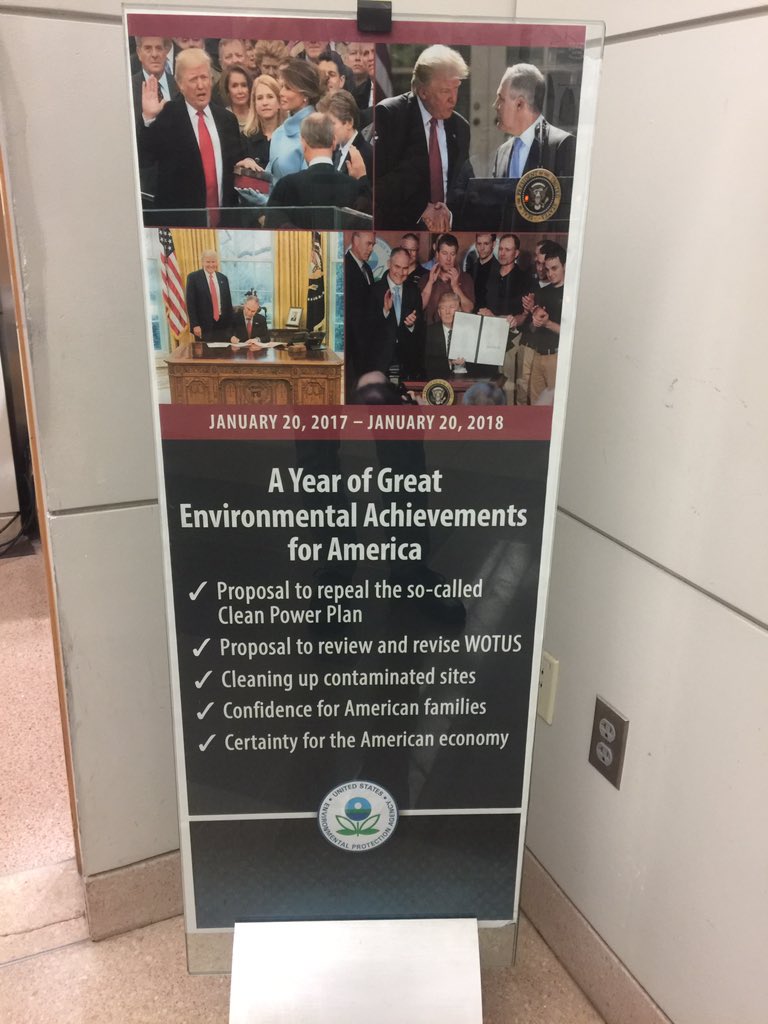
Yet since he was confirmed last February, EPA Administrator Scott Pruitt has worked to stall or roll back this core function of his agency, efforts he’s now celebrating with posters:
He’s also taken some highly unusual, even paranoid, precautions, arming himself with a 24/7 security detail, building a $25,000 secret phone booth in his office, spending $9,000 to sweep his office for surveillance bugs, and hiding his schedule from the public. When one employee turned one of the celebratory posters around, Pruitt assigned a worker to look through security camera records to see who did it.
Pruitt’s posters are a list of the regulatory rollbacks he’s delivered to his allies in coal, oil, gas, and chemicals industries. These gifts include the reversal of a ban on chlorpyrifos, a pesticide linked to developmental problems in children.
Some of the biggest changes Pruitt has made at the EPA have come by not doing anything at all. He’s steering the EPA’s work at an agonizingly slow pace, delaying and slowing the implementation of laws and running interference for many of the sectors EPA is supposed to regulate.
With more staff and funding cuts looming, even fewer toxic chemicals and other environmental hazards will be banned or regulated, and the laws that protect Americans against them won’t be enforced.
“People will get sick and die,” Christine Todd Whitman, who served as EPA administrator under President George W. Bush, told Vox. “It’s that simple.” Some 230,000 Americans already die each year due to hazardous chemical exposures. “You stop enforcing those regulations and that number will go way up,” she said.
Chaos at the White House and on Capitol Hill has provided Pruitt cover for his activities, namely deregulating and dismantling the Environmental Protection Agency piece by piece. He has quietly positioned himself as the greatest threat to the EPA in its entire existence. But some lawmakers and the courts are starting to catch onto him. Since the EPA’s inception, it’s been the judiciary that’s again and again beaten back attempts to undermine the agency from the inside. This year is again shaping up to be momentous.
States are now suing to block Pruitt’s regulatory changes, and federal judges are starting to force him to speed up. Pruitt will have to choose between knock-down, drag-out legal fights to deliver for his allies in industry or fold and grudgingly enforce environmental rules. Whatever he decides, Congress, courts, industry, and activists will be watching.
Pruitt can’t simply repeal all the rules he doesn’t like, so he’s had to embrace a different strategy: stall. By stalling, Pruitt can effectively shift policy by doing nothing. If he leaves regulations in limbo or delays their implementation, industries get relief from environmental rules while the EPA retains plausible deniability.
Here are some of the EPA's actual achievments:
- The EPA announced it was seeking a two-year delay in implementing the 2015 Clean Water Rule, which defines the waterways that are regulated by the agency under the Clean Water Act.
- In May, the EPA stalled on tracking the health impacts of more than a dozen hazardous chemicals at the behest of a Trump appointee at the agency, Nancy Beck.
- The agency has said nothing and done nothing about counties that failed to meet new ozone standards by an October 2017 deadline and now face fines.
- Environmental law enforcement has declined; the rules are simply not being followed and the EPA ignores that fact.. By September, the Trump administration launched 30 percent fewer cases and collected about 60 percent fewer fines than in the same period under President Obama.
- The EPA delayed regulations on dangerous solvents like methylene chloride, a paint stripper, that were already on track to be banned, instead moving the process to “long term action.”
- The EPA asked for a six-year schedule to review 17-year-old regulations on lead paint.
- The implementation date of new safety procedures at chemical plants to prevent explosions and spills was pushed back to 2019.
- Pruitt issued a directive to end “Sue & Settle,” a legal strategy that fast-tracks settlements for litigation filed against the EPA to force the agency to do its job. The agency will spend more time in courts fighting cases that it’s likely to lose.
- The agency’s enforcement division now has to get approval from headquarters before investigating violations of environmental regulations, which slows down efforts to catch violators of laws like the Clean Water Act.
Losing the environmental protections established by the EPA could harm millions of Americans
The EPA is essentially an environmental public health agency. Its regulations directly affect millions of Americans as it diagnoses ailments in the air, water, and soil, to name a few, and prescribes solutions.
It has had a pretty great track record.
The Clean Air Act, for example, reduced conventional air pollutants by 70 percent since 1970. Substances like ozone, carbon monoxide, and lead have dangerous consequences for human health like heart attacks, strokes, and respiratory arrests.
According to one estimate, the legislation prevents 184,000 premature deaths each year and has saved $22 trillion in health care costs over a period of 20 years.
But enforcing these rules bears a cost as well, and critics say that continuing to make many of these regulations stick costs businesses more and more to comply with them. This is the main rationale for the White House’s aim to cut back on “job-killing” regulations.
Many of these regulations took years to put together and will require years to take apart, endeavors that would likely not resolve until well into President Trump’s second term.
The courts are losing their patience with the agency and are now forcing Pruitt’s hand
Federal courts don’t agree with Pruitt's deconstruction of the EPA and are no longer deferring to the new administration. Courts have already blocked the EPA’s efforts to suspend rules on methane emissions and denied the EPA’s request to spend years researching lead paint, instead giving the agency 90 days to come up with a new regulation.
“I think you’re going to see courts get more involved in the work of the agency,” said former EPA general counsel Avi Garbow, who served under President Obama. “That judicial patience cannot be counted on forever.”
Some states are suing the department for not controlling air pollution moving across state lines. Some of the scientists who were ousted from the EPA’s advisory boards are now suing the agency, arguing that their removal violates the Federal Advisory Committee Act. Public lawsuits are also going forward to try to force the agency’s hand to fight climate change.
There are also some regulations Pruitt supports. He wants to remove lead from all drinking water in the United States in 10 years and has started taking comments on revising rules for water pipes. He also wants to control leaks of methane, the primary component in natural gas and a potent greenhouse gas.
All the while, lawmakers are also growing increasingly suspicious about Pruitt’s activities and are launching investigations. Michael Dourson, a former chemical industry consultant who was nominated to lead the EPA’s Office of Chemical Safety and Pollution Prevention, withdrew his name from consideration after facing stiff opposition from Congress.
The laws that govern the EPA require action, and whether those demands come from Congress, the courts, or constituents, the agency needs to produce results that stand up to legal challenges from all sides.
The goal is not to give industries a free pass from all responsibility for the environment, but to protect American lives. Pruitt may soon find out that doing nothing, or even very little, is not an option.
Saturday, January 27, 2018
Who does climate change affect?
We're seeing increased drought, storms, floods, crop damage and sea-level rise. Millions of people are fleeing their homes as a result.
The UN Refugee Agency says climate change is a 'threat multiplier' in many of today’s conflicts — from Darfur to Somalia to Iraq and Syria.
The effects will get worse as temperatures rise further. So we must cut greenhouse gas emissions to stop temperatures rising. But people also need protection from the climate change we can no longer avoid: that means financial support for developing countries and legal protection for climate refugees.
What causes climate change?
Our planet supports life because of the greenhouse effect — a blanket of gases trapping some of the sun’s rays. But increase the amount of these gases, and more heat is trapped. This causes the planet to heat up, and leads to a more extreme climate.
Our planet is warmer now than at any point in the past 800,000 years, and heating up fast. This is mainly a result of the huge increase in the amount of coal, oil and gas we’ve been burning since the industrial revolution, pumping carbon dioxide into the atmosphere.
Other things contribute to climate change too, such as deforestation, which means trees absorb less of these gases; and other greenhouse gases such as methane from cows.
Sha C. -----Jenny & Nanook's Knight
Thursday, January 25, 2018
Heat loss from Earth's interior triggers ice sheet slide towards the sea
Greenland’s ice sheet is becoming smaller and smaller. The melting takes place with increased strength and at a speed that no models have previously predicted.
In Scientific Reports, researchers from the Arctic Research Centre, Aarhus University, and the Greenland Institute of Natural Resources present results that, for the first time, show that the deep bottom water of the north-eastern Greenland fjords is being warmed up by heat gradually lost from the Earth’s interior. And the researchers point out that this heat loss triggers the sliding of glaciers from the ice sheet towards the sea.
Icelandic conditions
“North-East Greenland has several hot springs where the water becomes up to 60 degrees warm and, like Iceland, the area has abundant underground geothermal activity,” explained Professor Soren Rysgaard, who headed the investigations.
For more than ten years, the researchers have measured the temperature and salinity in the fjord Young Sound, located at Daneborg, north of Scoresbysund, which has many hot springs, and south of the glacier Nioghalvfjerdsfjorden, which melts rapidly and is connected to the North-East Greenland Ice Stream (NEGIS).
By focusing on an isolated basin in the fjord with a depth range between 200 and 340 m, the researchers have measured how the deep water is heated over a ten-year period. Based on the extensive data, researchers have estimated that the loss of heat from the Earth’s interior to the fjord is about 100 MW m-2. This corresponds to a 2 megawatt wind turbine sending electricity to a large heater at the bottom of the fjord all year round.
Heat from the Earth’s interior – an important influence
It is not easy to measure the geothermal heat flux – heat emanating from the Earth’s interior – below a glacier, but within the area there are several large glaciers connected directly to the ice sheet. If the Earth releases heat to a fjord, heat also seeps up to the bottom part of the glaciers. This means that the glaciers melt from below and thus slide more easily over the terrain on which they sit when moving to the sea.
“It is a combination of higher temperatures in the air and the sea, precipitation from above, local dynamics of the ice sheet and heat loss from the Earth’s interior that determines the mass loss from the Greenland ice sheet,” said Soren Rysgaard.
“There is no doubt that the heat from the Earth’s interior affects the movement of the ice, and we expect that a similar heat seepage takes place below a major part of the ice cap in the north-eastern corner of Greenland,” said Soren Rysgaard.
The researchers expect that the new discoveries will improve the models of ice sheet dynamics, allowing better predictions of the stability of the Greenland ice sheet, its melting and the resulting global water rise.
Thanx : Arctic Research Centre, Aarhus University, and the Greenland Institute of Natural Resources
Jenny the Crusader
Sunday, January 21, 2018
'WATCHING EARTH BREATHE
Amazing NASA map shows how climate change altered the face of our planetTHIS amazing NASA map of Earth from multiple satellites shows climate change has altered the face of our planet in the past 20 years.
The data visualisation, released this week, shows Earth's fluctuations as seen from spaceNASA
The data visualisation, released this week, shows Earth's fluctuations as seen from space
Polar ice caps and snow cover are shown ebbing and flowing with the seasons.
Varying ocean shades of blue, green, red and purple depict the abundance or lack of undersea life.
Two decades of imagery from September 1997 to this past September are crunched into minutes of viewing.
NASA oceanographer Jeremy Werdell said: "It's like watching the Earth breathe, it's really remarkable.
This map shows the biology changes on earth as viewed from space. The images focus on changes in the Middle East
"It's like all of my senses are being transported into space, and then you can compress time and rewind it, and just continually watch this kind of visualisation."
Werdell said the visualisation released this week shows spring coming earlier and autumn lasting longer in the Northern Hemisphere.
And he notices the Arctic ice caps and the Antarctic receding over time.
Werdell was struck by "this hugely productive bloom of biology" that exploded in the Pacific along the equator from 1997 to 1998 when a water-warming El Nino merged into cooling La Nina.
The algae bloom is evident by a line of bright green.
In Lake Erie in Canada, more and more contaminating algae blooms are apparently appearing red and yellow.
The NASA data can provide resources for policymakers as well as commercial fishermen and many others, according to Werdell.
Programmer Alex Kekesi of NASA's Goddard Space Flight Center in Maryland said it took three months to complete the visualisation, which was made using satellite imagery.
Thanx NASA
Jonny L. C.
Thursday, January 18, 2018
CLIMATE CHANGE :Will Polar Bears Die Out Because of Climate Change?
BY LISA FELDKAMP
Everyone has heard that polar bears are threatened by climate change. But what does that mean, exactly? Will they eventually go extinct, morph into another species, or something else? What does the science really say?The Top line: No Sea Ice, No Seals, No Polar Bears
As with most species that are or will be vulnerable to climate change, habitat is key in the case of the polar bear. Climate change is warming the Arctic along with the rest of the planet — and in the Arctic, that means sea ice is melting.
And sea ice is crucial for polar bears survival.
Why? Because polar bears’ main prey — seals — are best hunted on sea ice. Without sea ice, polar bears cannot catch enough seals to eat — and without enough seals to eat, they are unlikely to gain enough weight to survive their autumn to summer .
In addition, longer periods between successful hunts decrease polar bears’ reproductive success. A female polar bear who has not gained sufficient weight may not produce cubs; may produce less milk (leading to smaller, less viable cubs); or may abandon cubs — all behaviors that, if they become prevalent enough, will impact a population’s viability (Robbins 2012).
Most scientists agree that these trends spell likely trouble for polar bears.
There are 19 distinct sub populations of polar bears living in the Arctic, and each population will be affected somewhat differently.
Without human intervention, most polar bear populations will be extinct in 30-40 years .
The populations of polar bears living farthest to the north (in the Canadian Arctic Islands, northern Greenland, and farther to the north) have actually seen population increases in recent years .
However, they will be at risk from continued climate fluctuation ; contaminants in the Arctic ; increased disease risk .
But Can’t They Eat Something Else?
If nothing is done, lack of sea ice will force polar bears on land for longer periods of time. On land, bears “fast” eating some berries, eggs and birds .
However, scientists’ opinions are mixed on whether these foods could provide enough added energy for the long-term survival of these large bears.
Bears would still need to get some food from hunting seals; the question is, how many calories could be offset by terrestrial sources?
A polar bear in the Hudson Bay.
“The nests don’t run away from them like a caribou might,” Iles told Nat Geo. “It’s a ton of calories just basically sitting there that the bears can take advantage of.”
Nevertheless, Iles cautioned that we don’t really know if the bears will take advantage of this bounty.
“We need to do more research to figure out how much benefit this will really be to polar bears, the effects that this will really have on snow goose populations, and how sustainable this type of predation will be, depending on how severe it is,” he told Nat Geo.
But in the same story, Steven Amstrup, chief scientist for Polar Bears International, warned that nothing might replace what polar bears’ current habitat provides them.
“Unfortunately, we have no evidence to suggest that eating geese, or eating char, or eating anything else has any ability to offset the loss of the sea ice and the [primary] foraging opportunities it presents for polar bears,” Amstrup said.
Though Iles is cautiously optimistic about the possibility that polar bears could survive on goose eggs, his recent publication in Polar Biology found that adult geese were an unlikely source of energy for bears . Other studies have expressed doubt that polar bears could survive by foraging on land at all .
Northern populations of polar bears may stay in place and continue eating seals, but not the same species. The changes in Arctic temperatures have caused subarctic species of seals to move farther north, and the northern polar bears are now eating them. These seals carry more man-made contaminants, which may affect polar bears .
Migrating South Instead of North and Interbreeding with Grizzlies
You might expect that polar bears would move north to find colder climates and sea ice to hunt on — but actually, sea ice drifts south as it breaks up. For this reason, polar bears in some populations are more likely to move south to stay with the ice .
Some Hudson Bay population polar bears have already been spotted farther south of their normal territory, leading to an increased number of conflicts between humans and bears .
If southern polar bears cannot find a better food source on land, then they will die off as a result of starvation unless humans begin to feed them .
Furthermore, even if polar bears manage to find food as they move south, they may hybridize with populations of closely related grizzly bears — essentially causing the extinction of a distinct polar bear species .
Possible Next Steps: Reducing Emissions and More Drastic Measures
One possibility: Do nothing, and watch to see if polar bears “sink or swim.” But since climate change is a human-caused problem, doing nothing to mitigate its effects or help affected animals is unpalatable to many .
AA polar bear cub at the Detroit Zoo. Photo credit: Dave Hogg/Flickr through a Creative Commons license.
One of the most important things that we can do — and that we should do anyway because of all the other impacts climate change will have on people and nature — is to start cutting our carbon emissions, right now. (Find out more about your carbon footprint and how you can reduce it.)
The science says that significant reductions in greenhouse gas emissions alone could be enough to protect northern populations of polar bears indefinitely and to give southern populations a chance of survival .
But should we not reduce carbon emissions significantly enough to keep polar bear habitat intact, observers have suggested at least three other options for saving polar bears:
+ Polar bear populations could be fed and managed in or near the areas that they currently occupy. This would be costly, but it would keep the bears alive and maintain the tourist industry that has sprung up around these charismatic animals .
+ Existing zoos and new specially designed zoos could take in large numbers of polar bears. This option would preserve the species and would provide opportunities for education, but it would be difficult to return the bears to the wild if conditions ever became suitable for them in the distant future .
+ People could move polar bears to the Antarctic, where sea ice is expected to remain indefinitely. This would have serious ramifications for Antarctic species like penguins, but if polar bears were located at a distance from penguin colonies and both populations were managed, it could preserve the species as a wild population. We could also move other Arctic species to the Antarctic to increase biodiversity, though such moves may have unforeseen negative effects on the current ecosystem (Albrecht 2013). While this was suggested more as an exercise in making people think about impacts, a smaller scale relocation has been considered
Thanx Lisa Sharon L . C.
Lisa Feldkamp is the senior coordinator for new science audiences. She got her start with the Nature Conservancy through the ACLS Public Fellows program. (American Council of Leaned Societies)
Attention : Jenny the Crusader and her Knights will be telling you about space , our planet and lots of interesting things . Come back regular , we love exploring our planet .
Wednesday, January 17, 2018
Let's Take Back Our World Before it's too Late
my poppa was the smart man in the world he teach me good things, i do not get to see him anymore he is gone to heaven to pinh the angel i want to get as smart as poppa
It funny when poppa bend over you hear gas leaks poppa say it is my dog scout .
poppa told us lot about climte change how we can help put your plastc in a buckt so the plastc would not get in the river and ocean .
Poppa told us that the driling make earthqute people put a lot of gas other burning stuf in the air that mak the earth warm melt the ice some animal and people depend on the ice to live and get food from the ocean we try to tell people how to help save the world we are nanook polar bear cub and jenny the cursder knghts help us change the world to a better place .
i am 9 years old i can see the world is in troble join us we are going places .
thank you for reading
by G Man C Juniur
Subscribe to:
Posts (Atom)