Tuesday, January 22, 2019

Tree Huggers Unite

 
Loving trees and everything they represent …. and appreciating what they give us, opens our minds and hearts to other wonderful works of nature. So go hug a tree and it will hug you back
 (in a manner of speaking).  However, If it actually hugs you back, or speaks to you … run like heck.

Monday, January 21, 2019

Super Blood Wolf Moon ... Skywatcher's delight

21 January Lunar eclipse
 
A lunar eclipse, which some are referring to as a "super blood wolf moon", has delighted skywatchers around the world.
During the spectacular event, the Earth's natural satellite turns a striking shade of red.
The entire eclipse was visible from North and South America, as well as parts of western Europe and north Africa.

What is a total lunar eclipse?

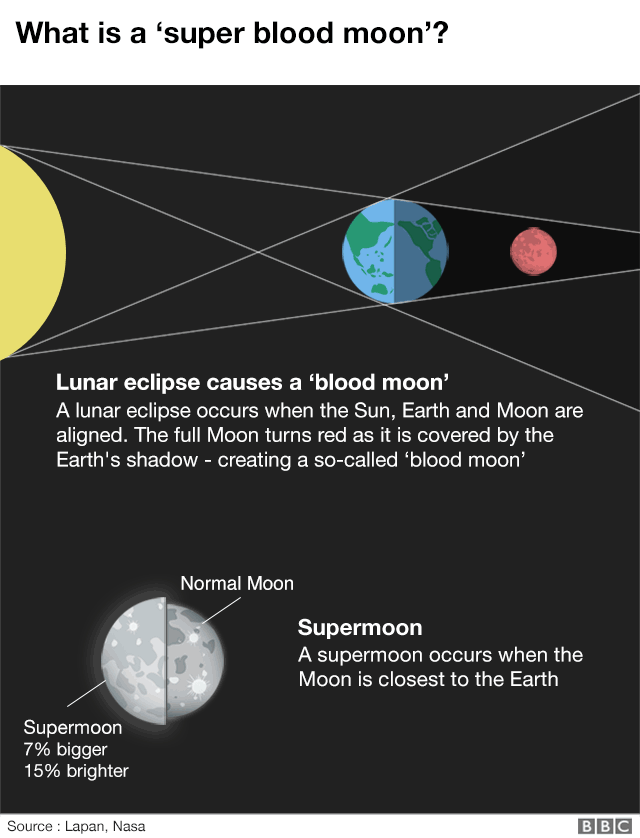
This kind of eclipse occurs when the Earth passes precisely between the Sun and the Moon.

Super blood wolf moon
In this situation, the Sun is behind the Earth, and the Moon moves into the Earth's shadow.
 
Blood moon explanation graphic
 
A full moon rises between clouds as a landing commercial jet approaches the airport before the start of a total lunar eclipse that is called a "Super Blood Wolf Moon" in San Diego, California

Will the moon appear red?

Yes. Some commentators are referring to the event as a "super blood wolf moon". The "super" part comes from the fact that the Moon will be near its closest approach to the Earth - when it will be marginally bigger in the sky than usual. The "wolf" part comes from the name given to full moons in January - "wolf moons".
Walter Freeman, an assistant teaching professor at Syracuse University in New York state, said: "A little bit of sunlight is refracted by the Earth's atmosphere and reaches the Moon, bending around the edges of the Earth. This small amount of red light still illuminates the Moon enough for us to see.

The moon seen beside a quadriga on top of the Cinquantenaire arch in Brussels

The moon seen beside a quadriga on top of the Cinquantenaire arch in Brussels
 
Super blood wolf moon through trees at night

Where was it visible?

The eclipse began at 02:35 GMT on Monday and ended at 07:49 GMT, but the point of greatest eclipse occurred at 05:12 GMT.
In the UK, the Moon was above the horizon throughout the eclipse, though from the extreme south-east of England the Sun had risen as the eclipse ended
This eclipse was also visible in north-western France, north-western Spain, Portugal, a small part of west Africa, almost the whole of North and South America, the eastern Pacific, and the north-eastern tip of Russia.

Was it safe to look at?

While solar eclipses are dangerous to view directly, the light from lunar eclipses is much fainter and so is completely safe to view without special equipment.

Why is it significant?

The event was the last chance for skywatchers to see a total lunar eclipse in its entirety until 2029 - weather permitting.

Super blood wolf moon and church

Thanx to BBC

Friday, January 18, 2019

Global warming is fueling stronger ocean waves

"For the first time, we have identified a global signal of the effect of global warming in wave climate," said researcher Borja G. Reguero.
Brook Hayes        Jan  14 , 2019
Global wave energy is increasing as ocean temperatures rise. Photo by UPI/Shutterstock/Ethan Daniels

Jan. 14 (UPI) -- Waves around the world are getting stronger as a result of the energy provided by global warming.

According to a new paper published in the journal Nature, scientists have discovered a correlation between increases in ocean temperatures and wave energy.

Climate scientists have mostly focused on the effects of climate change on ocean temperatures, ocean currents, sea level rise and melting sea ice, but new research suggests surface-level wind speeds and wave heights are changing as ocean temperatures increase.

"For the first time, we have identified a global signal of the effect of global warming in wave climate," Borja G. Reguero, researcher in the Institute of Marine Sciences at the University of California, Santa Cruz, said in a news release. "In fact, wave power has increased globally by 0.4 percent per year since 1948, and this increase is correlated with the increasing sea-surface temperatures, both globally and by ocean regions."

The influence of global warming on global wave power is strong enough that scientists think the measurement could be used as an important indicator of climate change's influence on ocean and atmospheric systems -- on par with indicators like carbon dioxide concentration and the global sea level rise.

Wave energy is the most powerful driver of coastal change and flooding, affecting where and how coastal communities build infrastructure -- harbors, levees and breakwaters. Increases in global wave power can amplify the impacts of sea level rise on coastal communities.

"Our results indicate that risk analysis neglecting the changes in wave power and having sea level rise as the only driver may underestimate the consequences of climate change and result in insufficient or maladaptation," said Fernando J. Méndez, associate professor at the University of Cantabria.
Thank   Brook  Hayes
Knight  Sha

It is too cold to play outside today..... 30 degrees below freezing with a wind chill factor that makes it 40 below freezing. We are staying close to the fire. There will be 15 centimeters of snow tonight. Too deep for little dogs to walk around in. Mika and I intend to have a long winter nap while Knight Aunt Jeannie gets out the snow-blower and tries to dig us out. Come on over and rub my belly.

Wednesday, January 16, 2019

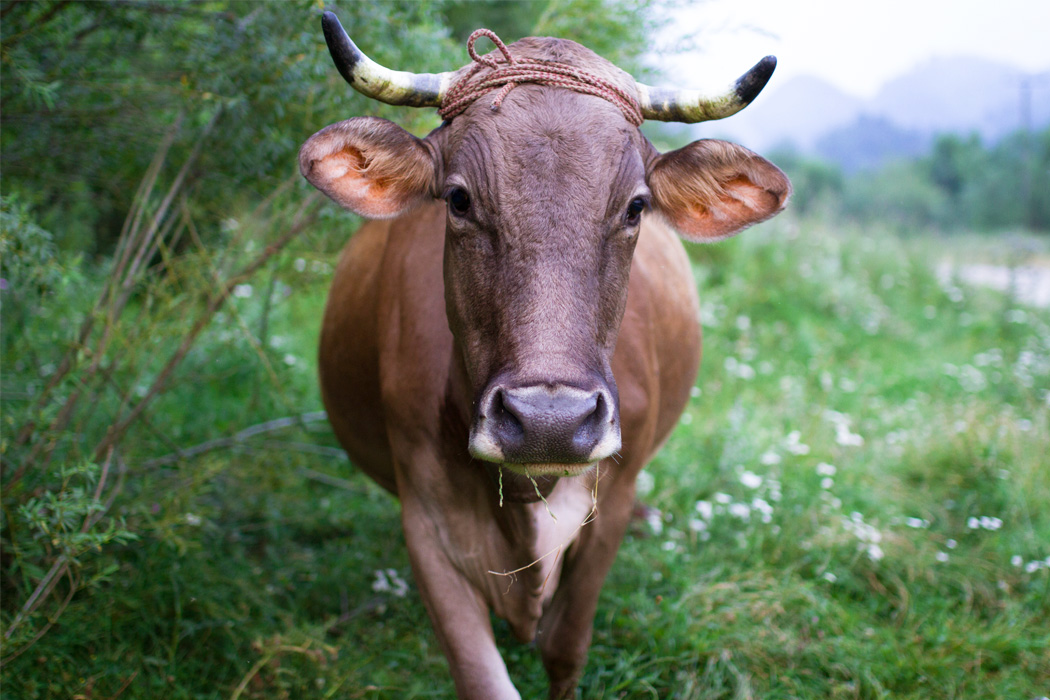
Can Cows Help Mitigate Climate Change? Yes, They Can!

By  Lela     Nargi
Sequestering carbon has become a topic essential to the broader conversation about how our planet might survive the escalating effects of climate change. Livestock are frequently demonized as the enemy of this process. That’s partly because raising animals for meat and dairy accounts for 5 percent of global carbon dioxide emissions; unsurprisingly, study after study—including the United Nations’ most recent, bleak climate report—affirms that humans need to reduce consumption of animal-based products in order to fend off planetary disaster. This has led to the advent of a booming industry centered on plant-based “meats” and “milks,” buoyed by a rallying cry from some quarters to abolish meat and cheese and butter and eggs from our diets wholesale.

Livestock farming such as Massy once practiced it—the way many farmers and ranchers continue doing it, by overgrazing of open grass- and rangelands, or by grazing lands not suited to the practice—can be an ecologically ruinous way to produce food. It can destroy soil health and biodiversity, emitting greenhouse gasses in the process, including carbon dioxide. And yet, research also confirms that livestock provide ecological services too great to warrant their complete removal from the landscape.

Properly managed under the right confluence of conditions, cattle, hogs, sheep, goats, and chickens can help mitigate degraded soils and restore healthy ecosystems, which helps lock carbon deep in the ground. About 40 percent of ice-free land on earth is considered grazing land, which sequesters about 30 percent of our planet’s carbon pool.

Project Drawdown, a group of international scientists focused on climate research, lists silvopasture, a form of livestock production that comingles trees with pastureland, number nine on its list of 80 modeled solutions to reverse climate change. It lists managed grazing—what a much-reformed Massy practices today—at number 19.

“The best way to address the carbon issue is to use animals in an ecological fashion,” Massy says. “We need [them] in the landscape.”

How Carbon Is Sequestered
Every plant plays the vital function of removing carbon dioxide from the atmosphere, via photosynthesis. Using sunlight’s energy, the plant fuses that carbon with hydrogen and oxygen to make carbohydrates, which it moves into the soil through its roots. (It also maintains some carbon in its own leaves and shoots and stems.) The roots feed the carbohydrates to dirt-bound fungi; in return, the fungi feed minerals back to the plant. As Mother Earth News describes it, “This invisible partnership…is the foundation of the terrestrial carbon cycle, as plants incorporate carbon from atmospheric carbon dioxide into carbohydrate biomass.”

The longer a plant’s roots, the deeper it can sequester carbon in the soil and the more efficiently it can hold it there. A healthy grassland, with a diversity of region-specific native grasses—on Massy’s farm, some of which have roots that extend four feet into the ground—can create deep carbon sinks. Managing grasslands well also contributes to carbon storage other ways: by building up soil health to make land more resilient to extreme events, according to Marcia DeLonge, senior scientist in the Food & Environment Program at the Union of Concerned Scientists. This, she says, “can protect existing soil carbon to some degree, but perhaps more importantly may allow continued carbon sequestration. In other words, even when events like extreme heat, drought, fire, and floods don’t significantly affect soil carbon immediately, they could affect the plants above ground that contribute to soil carbon in the longer term.”

Trees generally capture and store more carbon than grasses and shrubs. Size, density and longevity all factor into this ability; tropical staple crop trees are especially good at it. And tropical forests sequester half our terrestrial carbon—about 470 billion tons worth.

Often working against these heroic efforts on the part of plants and trees, though, is agriculture. To produce some of the food we need in order to live, we disturb or destroy our carbon-storing ecosystems. We run animals through them in unsustainable ways, or we chop them down and plow them up to raise monocultures of crops like corn and soy—some of them to feed livestock, others to produce the fake meat that’s meant to replace real meat—that require still more plowing, as well as the application of chemicals that kill beneficial soil bacteria, fungi, insects. The land becomes degraded, and carbon-poor.

Improbable and illogical as it may seem, livestock can help.
The trampling of the sheep’s hooves mixes manure with soil, fertilizing it and depositing organic matter. That opens up the soil, seeds it, and allows plant roots to go deeper without tilling or plowing. Credit: Lela Nargi
The Benefits of Animals: Managed Grazing
That disastrous storm on Massy’s farm was followed by five years of drought. Across Australia, over-cleared, over-grazed grasslands suffered, susceptible to dust storms and erosion. Massy, though, began to “swing toward ecological grazing and cropping,” he says, educating himself by visiting other farmers who’d recognized the destructiveness of ranching-as-usual.

That swing meant rotating sheep more frequently from paddock to paddock, giving grasses and forbs a long rest in order to bounce back. It meant seeding in more and various plants adapted to the parched soil, including nitrogen fixers such as alfalfa. The trampling of the sheep’s hooves mixes manure with soil, fertilizing it and depositing organic matter. This action opens up the soil, seeds it, and allows plant roots to go deeper–all without the destruction of tilling or plowing. Over time, “native grasses, forbs, and legumes that seemed to have disappeared slowly returned,” Massy says. So did many species of wildlife: “We now have over 140 bird species, four macropod species, and much else.”

If managed grazing could be amped up worldwide, it could sequester over 16 gigatons of carbon by 2050.
According to Project Drawdown, livestock grazing occupies one-quarter of land area in the world—some 3.3 billion hectares. It estimates that 79 million hectares already employ managed grazing along the lines of what Massy now practices on his farm, although it considers 1.3 billion hectares of the earth’s plant-able surface to be wet enough to be suited to this practice. If managed grazing could be amped up worldwide, it could sequester over 16 gigatons of carbon by 2050.

What managed grazing does not do, is eliminate methane and nitrous oxide emissions. And yet, Project Drawdown found that carbon sequestration more than offset them. “If we can figure out where the best places to have rangelands are, and make sure they’re well managed, we can gain all these benefits,” says DeLonge.

More Animal Benefits: Silvopasture
Massy has done another important thing across his rangelands over the past 10 years: He’s planted 50,000 native trees and shrubs, building on efforts begun by his father in the 1960s. That is exactly what silvopasture is, and it increases soil biodiversity and the carbon-storing potential of animal husbandry. Eric Toensmeier, who researches Project Drawdown’s food-supply land use, calls it “a powerful tool…that is not being taken seriously.”

How powerful? Project Drawdown estimates that silvopasture can sequester almost two tons of carbon per acre per year, making it one of the most effective carbon-storing tools in agriculture. This power is already recognized in countries like Brazil, Australia, and Mexico, where governments give farmers financial incentives to transition to silvopasture systems. So far in the U.S., though, it remains little-known and -understood.

With some notable exceptions—like on Steve Gabriel’s 35 acres of once-nutrient-poor hayland outside Ithaca, NY. There, Gabriel, an agroforestry specialist in Cornell University’s Small Farms Program, has been experimenting with silvopasture for the past five years. He wrote a guidebook to it for North American farmers interested in learning more about it, based partly on his own experience.

“When we got [the farm], there was pretty poor diversity—a lot of goldenrod, a lot of woody stuff, soil that didn’t soak up water very well after rain because it had become compacted from having machinery driven over it for decades,” Gabriel says. He introduced a flock of sweet-tempered Katahdin sheep and quickly saw “a transformation of the soil as they freed up nitrogen and nutrients and fertilized it at the same time,” transforming the land into vibrant pastures rich with clover, plantains, wildflowers, and grasses.

In two pastures Gabriel planted black locust trees and says he began to notice an increase soil organic matter—that is, decomposing plant and animal bits that provide a steady nutrient supply to everything growing in it—which, according to Toensmeier, also increases soil carbon and carbon storage in above-ground biomass. The trees have a range of other uses. They provide shade to the animals, as well as nutritious forage—Gabriel supplements the animals’ grass grazing with locust branches he snips off the trunk.

The main reason Gabriel chose black locusts as plantings is because they’re fast-growing and “the faster the tree grows, the more carbon it’s going to sequester,” he says, at least in its early decades, both in the soil and in the tree’s trunk, branches, leaves. He’s been experimenting with willows, too, which potentially have an added climate bonus when munched by livestock: Their tannins might slow down digestion, reducing methane emissions.

In the longstanding woodlands that surround his open pastures, Gabriel uses the sheep to clear out underbrush. This frees the ground up for shelter, and for the seeding in of forage grasses, which can lead to soil remediation and—potentially, in the long run—carbon storage.
When managed properly, livestock can help sequester carbon or keep invasive brush under control. Credit: Trisha Dixon
The Even Bigger Picture About Why Any of This Matters
“Getting invasive brush under control with [livestock] is a beautiful, elegant practice,” says Toensmeier, “but I can’t tell you the carbon balance—it’s certainly not as powerful as fresh trees in pasture.” But other researchers have found that there are benefits to letting (carefully managed) livestock into a woodlot to tidy it up.
Thanx  Lela  Nargi

Knight  Man

Tuesday, January 15, 2019

Does Organic Agriculture Contribute to Climate Change?

Organic agriculture seems like it would be better for the environment than conventional. But a new study suggests it produces more carbon dioxide.
By: James MacDonald January 14, 2019   3 minutes
 Which is better for the environment: organic or conventional agriculture? For consumers trying to make sound food choices, it’s an important question. A new international study finds that organic agriculture actually contributes more to climate change than conventional farming does. The study argues that since organic agriculture requires slightly more land for the same yield, organic systems lead to more deforestation, which in turn results in more carbon dioxide emissions. But measuring environmental impact is extremely complicated.

When it comes to climate, the fertilizer issue is key.
Back in 2010, Nadia El-Hage Scialabba and Maria Müller-Lindenlauf, of the Food and Agriculture Organization of the United Nations (FAO), took an in-depth look at the climate impacts of organic agriculture. F.A.O.’s Codex Alimentarius Commission defines organic agriculture as:

A holistic production management system that avoids use of synthetic fertilizers, pesticides and genetically modified organisms, minimizes pollution of air, soil and water, and optimizes the health and productivity of interdependent communities of plants, animals and people.

Organic agriculture still uses fertilizers and pesticides, but not synthetic ones. And when it comes to climate, the F.A.O study suggests, the fertilizer issue is key.

Conventional agriculture relies on nitrogen fertilizers, produced through a process involving copious amounts of ammonia and methane. Nitrogen fertilizers in turn, release some degree of nitrous oxide, an extremely potent greenhouse gas, with a much greater warming potential per unit released than carbon.

Organic farms bypass the need for chemical fertilizers by planting legumes. Organic farms also tend to store more carbon in the soil, slightly offsetting other greenhouse gas emissions, though, as the F.A.O. study notes, the carbon storage is likely not permanent. Plus, organic farms may burn more fossil fuels through machinery when weeds are removed mechanically.

As for the suggestion that organic agriculture requires slightly more land for the same yield, it depends on the crop. Conventional dairy production, for example, produces much more milk per cow. But there is hardly any yield difference when it comes to organic vs. conventional rice. In some cases, the same crop may have different yields-per-area in the developing world vs. the developed world—organic yields are often higher in developing countries. This is because, as the F.A.O. report notes, some of the ecologically sound practices are difficult to scale up to industrial levels, and work better at smaller scales.

On the other hand, grass-fed livestock requires a lot more space than feedlots, often leading to deforestation.

Many conscious consumers want a definitive answer about whether conventional or organic farming is better, when in fact, both have effects on the climate. There are also other concerns that go into consumer choices, such as animal welfare. And, as Stefan Wirsenius, one of the authors of the international study, says, “The type of food is often much more important. Eating organic beans or organic chicken is much better for the climate than to eat conventionally produced beef.”

 JSTOR is a digital library for scholars, researchers, and students. JSTOR Daily readers can access the original research behind our articles for free on JSTOR.
Thanx  James  MacDomald
Knighr Jonny

U.S. top court rejects Exxon in climate change document dispute

Nate Raymond                   JANUARY 7, 2019
(Reuters) - The U.S. Supreme Court on Monday cleared the way for the attorney general of Massachusetts to obtain records from Exxon Mobil Corp(XOM.N) to probe whether the oil company for decades concealed its knowledge of the role fossil fuels play in climate change.
FILE PHOTO: A logo of the Exxon Mobil Corp is seen at the Rio Oil and Gas Expo and Conference in Rio de Janeiro, Brazil September 24, 2018. REUTERS/Sergio Moraes
The justices declined to hear Exxon’s appeal of a ruling by the top court in Massachusetts holding that state Attorney General Maura Healey, a Democrat, had jurisdiction to seek records to probe whether the company misled consumers and investors.

The high court’s action marked the latest setback for Exxon in its efforts to halt the Massachusetts investigation and a similar one by New York’s attorney general, who in October filed a lawsuit against the company.

New York’s lawsuit accused Exxon of engaging in a systematic scheme to deceive investors about the impact that future climate change regulations could have on its business. Exxon has called the claims “meritless.”

The Massachusetts and New York investigations were launched following 2015 news reports that Exxon’s own scientists had determined that fossil fuel combustion must be reduced to mitigate the impact of climate change.

Those news reports, by Inside Climate News and the Los Angeles Times, were based on documents from the 1970s and 1980s. Exxon said the documents were not inconsistent with its public positions.

Healey in 2016 issued a civil investigative demand to Exxon seeking documents to investigate whether it had violated the state’s consumer-protection law through its marketing and sale of fossil fuel products.

Exxon said that because it is incorporated in Texas and New Jersey, Healey had no basis to seek documents to conduct a Massachusetts-based investigation.

The Massachusetts Supreme Judicial Court in April held that jurisdiction existed because of Exxon’s control over advertising conducted for about 300 franchise gas stations operating under the Exxon and Mobil brands in Massachusetts.

Exxon has called the Massachusetts and New York investigations politically motivated.

Reporting by Nate Raymond and Lawrence Hurley; Editing by Will Dunham
Thanx  Nate Raymond  & Lawerance Hyrley

Knight Jonny