Sunday, February 10, 2019

President Trump, here’s ‘what the hell is going on’ with global warming

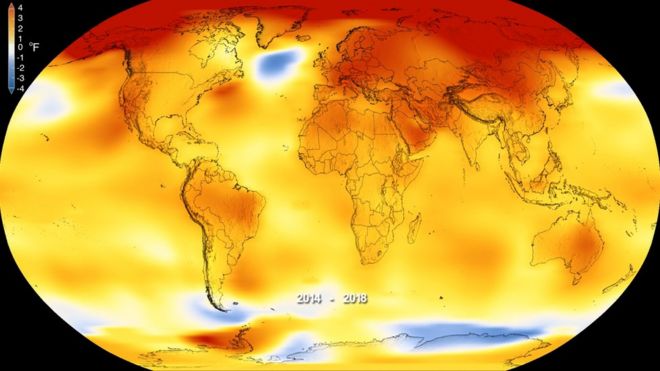
A map shows global surface temperature anomalies for 2014 through 2018. Higher than normal temperatures are shown in red, and lower than normal temperatures are shown in blue. (Kathryn Mersmann/NASA - Scientific Visualization Studio/AP)
By Editorial Board February 7
“WHAT THE hell is going on with Global Waming?” President Trump tweeted last week in the midst of a cold snap. “Please come back fast, we need you!”

If Mr. Trump had consulted scientists in the government he works for, they could have helped with his basic understanding, as well as his spelling: The warming of the Earth is unmistakable, as seen in a global temperature record that offers no reason for laughter. Experts from NASA and the National Oceanic and Atmospheric Administration announced Wednesday that 2018 was the fourth-warmest year on record, according to two separate estimates, one from each agency.

A single year’s temperature readings do not constitute a trend. But there is a trend. The five warmest years have come in the past five years. Eighteen of the 19 warmest years on record have come since the beginning of this century. That 2018 did not quite match the record-setting 2016 for warmth is in part because a warming El Niño effect in 2016 raised temperatures even higher than human influence alone would have. By contrast, 2018 saw a cooling La Niña and was still fourth-warmest. The overall direction is relentless: This decade will be warmer than the last, which was warmer than the one before it, and so on.

As more and more of their predictions have come true, scientists have become more confident in their models — and more alarmed. Some effects of climate change remain difficult to predict or plan for. Warming could even contribute to cold snaps such as the one that prompted Mr. Trump to mock climate science on Twitter last week. Other effects are all too predictable: rising seas, stronger storms, more heat waves, more droughts, more flooding, invasive species, the proliferation of disease, depleted fisheries, dying ecosystems, more acidic oceans, crop failures, mass migrations, days so hot that people cannot work. Experts warn that Americans are already likely feeling global warming’s influence in the super-wet storms that have pummeled places such as Houston, feeding on extremely warm waters in the Gulf of Mexico.

In the face of ever-rising evidence, the president did not even mention climate change in Tuesday’s State of the Union address. His administration still intends to remove the United States from the Paris climate agreement, the world’s best hope to get all major contributing countries moving in the same direction. While the Trump administration ripped up clean-air rules, U.S. greenhouse-gas emissions shot up 3.4 percent last year, putting the lie to the argument that market forces alone will adequately drive down the country’s carbon footprint.

Some Democrats, meanwhile, have announced a “ Green New Deal” whose goal seems to be radically reshaping U.S. society and vastly expanding government rather than simply addressing the climate problem, which is hard enough — and important enough. Though not nearly as harmful as Mr. Trump’s rank denialism, engaging in this sort of fantasy also hurts the cause of practically addressing the issue.

What is the 'Green New Deal?'
An ambitious platform seeking to combat climate change is being championed by progressives like Rep. Alexandria Ocasio Cortez (D-N.Y.). (Video: Adriana Usero/Photo: Brian Monroe/The Washington Post)

The world needs rational U.S. leadership. Unfortunately, global warming will not stop in the meantime.
Thanx  Editorial Board

Knight Jonny

Thursday, February 7, 2019

See the source image

Earth Headed for Hottest Decade on Record

Nasa temperatures
  
The world is in the middle of what is likely to be the warmest 10 years since records began in 1850, say scientists. The Met Office is forecasting that temperatures for each of the next five years are likely to be 1C or more above pre-industrial levels.
In the next five years there's also a chance we'll see a year in which the average global temperature rise could be greater than 1.5C. That's seen as a critical threshold for climate change.  If the data matches the forecast, then the decade from 2014-2023 will be the warmest in more than 150 years of record keeping.

Will the forecast temperature rises bust the Paris climate agreement?

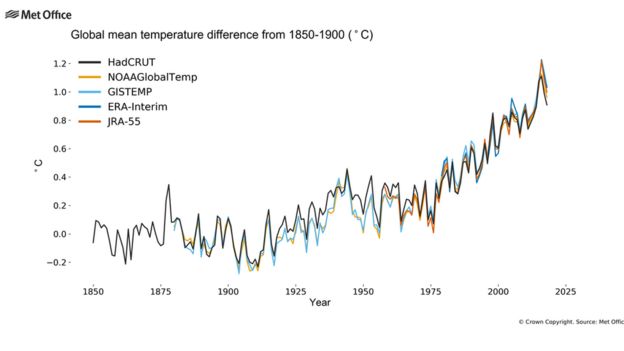
The Met Office says that 2015 was the first year in which the global annual average surface temperature reached 1C above the pre-industrial level, which is generally taken to mean the temperatures between 1850 and 1900.
Each year since then, the global average has hovered close to or above the 1C mark. Now, the Met Office says that trend is likely to continue or increase over the next five years

Warmest decade infographic

 
"We've just made this year's forecasts and they go out to 2023 and what they suggest is rapid warming globally," Prof Adam Scaife, head of long term forecasting at the Met Office, said.
"By looking at individual years in that forecast we can now see for the first time, there is a risk of a temporary exceedance of the all-important 1.5C threshold level set out in the Paris climate agreement."
Last October, UN scientists published a special report on the long-term impacts of a temperature rise of 1.5C.  They concluded that it would take a massive carbon cutting effort to keep the world from tipping over the limit by 2030. The Met Office analysis now says there's a 10% chance of this happening within the next five years.
"It's the first time the forecasts have shown a significant risk of exceedance. We are talking about individual years fluctuating above the 1.5 degree level," said Prof Scaife.
"But the fact that that can happen now due to a combination of general warming and the fluctuations due to things like El Niño events in the next few years does mean we are getting close to that threshold."
 
 
Met office graphic
Temperature data for the five major global climate databases
 

How confident is the Met Office of its prediction?

The Met Office says it has a 90% confidence limit in the forecasts for the years ahead.
It says that from 2019 to 2023, we will see temperatures ranging from 1.03C to 1,57C above the 1850-1900 level, with enhanced warming over much of the globe, especially over areas like the Arctic.
The research team says it is pretty certain in its predictions because of its past experience. The team's previous forecast, made in 2013, predicted the rapid rate of warming that's been observed over the past five years. It even predicted some of the lesser known details such as the patch of cooling seen in the North Atlantic and the cooler spots in the Southern Ocean
 
If the observations over the next five years match the forecasts, then the decade between 2014 and 2023 will be the warmest in more than 150 years of records.

What about other climate agencies?

The Met Office forecast comes as a number of agencies publish their full analysis of temperature data from 2018, showing it to be the fourth warmest since records began in 1850.
The World Meteorological Organization (WMO) has published an analysis of five major international datasets showing that the 20 warmest years on record have been in the past 22.
"Temperatures are only part of the story. Extreme and high impact weather affected many countries and millions of people, with devastating repercussions for economies and ecosystems in 2018," said WMO Secretary-General Petteri Taalas

 
hot city
                                             
"Many of the extreme weather events are consistent with what we expect from a changing climate. This is a reality we need to face up to. Greenhouse gas emission reduction and climate adaptation measures should be a top global priority," he said.
Other researchers in the field said the new forecast for the next five years was in line with expectations, given the record level of CO2 pumped into the atmosphere in 2018.
"The forecast from the Met Office is, unfortunately, no surprise," said Dr Anna Jones, an atmospheric chemist at the British Antarctic Survey.
"Temperatures averaged across the globe are at a record all-time high, and have been for a number of years. They are driven predominantly by rising concentrations of greenhouse gases, such as carbon dioxide, that result from our continued use of fossil fuels.
"Until we reduce greenhouse gas emissions, we can expect to see continued upward trends in global averaged temperatures."
That's the latest news folks. So how about ditching fossil fuels, eh????

Many thanx to the BBC


Wednesday, January 30, 2019

Trump administration 'wrecking ball' approach to science threatens public health and environment, report warns

President Donald Trump waves as he walks through the Colonnade from the Oval Office of the White House ( AP )
White House 'has ignored scientific findings on climate change, LGBTQ rights, taxes and other issues'
Valerie Strauss   
A report by the Union of Concerned Scientists says President Donald Trump and his administration have taken scores of actions that have ignored scientific findings on climate change, LGBTQ rights, taxes and other issues and that those actions are harming public health and the environment.

The report, The State of Science in the Trump Era: Damages Done, Lessons Learned, and a Path to Progress, says the organisation has documented 80 attacks on science by administration officials with limited scientific credentials and significant conflicts of interest, including direct ties to industries that agencies are supposed to regulate.

Donald Trump has repeatedly expressed opinions about climate change and other issues that contradict the best scientific research. He kept vacant the key position of chief of the Office of Science and Technology Policy – which informs federal policies on climate change, online privacy, artificial intelligence and other issues – longer than any president.

 “President Trump’s political appointees have taken a wrecking ball to science, which we all depend on,” Union of Concerned Scientists President Ken Kimmell said in a statement. “But the science community is more engaged than ever to fight back.”

The report said “the administration has compromised our nation’s ability to meet current and future public health and environmental challenges, and it continues to erode science across the federal landscape” by taking actions that include:

 “President Trump’s appointees to the Environmental Protection Agency and the Department of the Interior stand out for their glaring conflicts of interest and their hostility to the science-based mission of their agencies,” the report says. “Climate science and studies on the public health impacts of pollution have been especially targeted – demonstrating the administration’s commitment to helping politically powerful industries at the expense of the public good.”

The Union of Concerned Scientists, a nonprofit advocacy organization, said the level of political interference in science varies by agency and issue. But it noted that “both the courts and sustained pressure from scientists and their allies have prevented or restrained some of the worst abuses to date.”

Scientists and others have gone to the courts, the public-comment process and Congress to try to check the administration, and they have prevented the confirmation of some nominees and stalled some policies. The report offers a path for the new Congress, with its Democratic-led House, to safeguard scientific principles from damage by the executive branch.

“Congress has power to investigate attacks on science, defend the vital role of science in federal decision-making, and mandate increased protections for federal scientists,” the report says. “They have the power of the purse and must ensure that federal science and research remains well-funded, despite repeated attempts by the administration to cut budgets and staffing related to science. They should also demand that those nominated to lead federal agencies acknowledge and act upon the latest science.”

The report describes in detail examples of actions taken – or not – by the administration.

For example, it noted that Treasury Secretary Steven Mnuchin had promised comprehensive studies of the economic impact of the proposed Tax Cuts and Jobs Act before it became law and even said that more than 100 people “working around the clock on running scenarios” would provide evidence that the proposed $1.5 trillion tax plan would pay for itself through economic growth. No such analysis emerged, the report said, and “Treasury economists stated they were barred from conducting comprehensive analyses and that the analyses Secretary Mnuchin described did not exist.”

It said the Trump administration “repeatedly ignored, dismissed, or suppressed the science of climate change, limiting the ability of federal scientists to speak about, report on, or even study it” and has “removed, revoked, and suppressed mentions of climate change in agency documents.” Instead, it has pointed “to elements of uncertainty about the magnitude of impacts and the human causes of climate change rather than the overwhelming US and international consensus on its very significant risks and the unequivocal evidence that recent warming is primarily caused by human activities.”

An example of when scientists and other advocates successfully pushed back involved Scott Pruitt, the former EPA administrator who was forced out in July because of scandals. On his last day as administrator, he created a loophole that would have allowed a certain kind of truck to emit massive amounts of pollution, the report said. A coalition of public health groups, environmental activists, scientists and others lobbied against it and went to court. The new EPA administrator got rid of the change.

Thanx Valerie Strauss             Washington Post

Knight  Jonny

Monday, January 28, 2019

If all the ice melted


If we keep burning fossil fuels indefinitely, global warming will eventually melt all the ice at the poles and on mountaintops, raising sea level by 216 feet.
By releasing carbon dioxide and other heat-trapping gases into the atmosphere, we have warmed the Earth by more than a full degree Fahrenheit over the past century and raised sea level by about eight inches. Even if we stopped burning all fossil fuels tomorrow, the existing greenhouse gases would continue to warm the Earth for centuries. We have irreversibly committed future generations to a hotter world and rising seas. 

 The concentration of carbon dioxide in the atmosphere has surpassed 400 parts per million, the highest since three million years ago. Sea levels then may have been as much as 65 feet above today’s; the Northern Hemisphere was largely ice free year-round. It would take centuries for the oceans to reach such catastrophic heights again, and much depends on whether we manage to limit future greenhouse gas emissions. In the short term scientists are still uncertain about how fast and how high seas will rise. Estimates have repeatedly been too conservative.

Global warming affects sea level in two ways. About a third of its current rise comes from thermal expansion—from the fact that water grows in volume as it warms. The rest comes from the melting of ice on land. So far it’s been mostly mountain glaciers, but the big concern for the future is the giant ice sheets in Greenland and Antarctica. 12 years ago the Intergovernmental Panel on Climate Change (IPCC) issued a report predicting a maximum of 23 inches of sea-level rise by the end of this century. But that report intentionally omitted the possibility that the ice sheets might flow even more rapidly into the sea, on the grounds that the physics of that process was poorly understood.

Climate scientists now estimate that Greenland and Antarctica combined have lost on average about 50 cubic miles of ice each year since 1992—roughly 200 billion metric tons of ice annually. Many think sea level will be at least three feet higher than today by 2100. Even that figure might be too low. Coastal cities face a twofold threat: Inexorably rising oceans will gradually inundate low-lying areas, and higher seas will extend the ruinous reach of storm surges. The threat will never go away; it will only worsen.
Using a conservative prediction of a half meter (20 inches) of sea-level rise, the Organization for Economic Co-operation and Development estimates that by 2070, 150 million people in the world’s large port cities will be at risk from coastal flooding, along with $35 trillion worth of property—an amount that will equal 9 percent of the global GDP. How will they cope?

Debris from throughout the ages


Have human beings permanently changed the planet? That seemingly simple question has sparked a new battle between geologists and environmental advocates over what to call the time period we live in.
According to the International Union of Geological Sciences (IUGS), the professional organization in charge of defining Earth’s time scale, we are officially in the Holocene ( which means - “entirely recent”) epoch, which began 11,700 years ago after the last major ice age.
But that label is outdated, some experts say. They argue for “Anthropocene”—from anthropo, for “man,” and cene, for “new”—because human-kind has caused mass extinctions of plant and animal species, polluted the oceans and altered the atmosphere, among other lasting impacts.
Anthropocene has become an environmental buzzword ever since the atmospheric chemist and Nobel laureate Paul Crutzen popularized it in 2000. This year, the word has picked up velocity in elite science circles: It appeared in nearly 200 peer-reviewed articles, the publisher Elsevier has launched a new aca­demic journal titled Anthropocene and the IUGS convened a group of scholars to decide  whether to officially declare that the Holocene is over and the Anthropocene has begun. What did they decide?? They decided that we are indeed in the 'Anthropocene Age'.

Tuesday, January 22, 2019

Magnetic North's erratic behavior forces update to global navigation system

 By    Brooks Hays          
Earth's magnetic field is behaving erratically. The planet's shifting magnetic poles could cause navigational problems. Photo by Shutterstock

Jan. 14 (UPI) -- Magnetic North is shifting rapidly, throwing off the World Magnetic Model that powers a variety of global navigational systems.

Scientists were originally scheduled to release an updated model this week -- a fix for the accumulating anomalies -- but due to the government shutdown, the update's release has been delayed until the end of the month.

Scientists with the British Geological Survey and the U.S. National Oceanic and Atmospheric Administration update the World Magnetic Model every five years. The last full update came in 2015. Shortly afterwards, a portion of Earth's magnetic field briefly shifted deep beneath northern South America.

Over the last few years, the erratic behavior continued.

"Since late 2014 the core field has varied in an unpredicted, and currently unpredictable, manner," British Geological Survey scientist Will Brown wrote in a blog update. "This led to the WMM becoming less accurate, particularly at high northern latitudes."

Most recently, Magnetic North migrated rapidly into Siberia. According to a recent report by Nature, scientists realized the model was in serious trouble early last year.

"Researchers from NOAA and the British Geological Survey in Edinburgh had been doing their annual check of how well the model was capturing all the variations in Earth's magnetic field," Alexandra Witze reported. "They realized that it was so inaccurate that it was about to exceed the acceptable limit for navigational errors."

In December, NOAA issued a partial update to patch up the most glaring errors, but the model remains inaccurate. The forthcoming update is desperately needed.

Scientists think the magnetic field's erratic behavior is explained by changes in the flow of iron inside Earth's outer core. But it's also possible Earth's magnetic poles are on the verge of reversing.

The planet's magnetic poles flip every 200,000 to 300,000 years, but an attempted flip 40,000 years ago failed. Earth's poles haven't flipped in nearly 800,000 years. In other words, they're due.

RELATED Citizen scientists help solve mystery of the purple sky
Though powered by the swirl of iron and nickel in Earth's molten core, a variety of factors can influence the planet's magnetic field.

"The magnetic poles drift, the field strengthens and weakens, and the immense magnetic field of the sun, carried by the solar wind, constantly batters at it from the outside," according to Brown. "The effect of all these changes vary depending on when and where you are on, under, or above the Earth's surface."

Researchers with NOAA and BGS hope to gain a better understanding of what's driving the magnetic field's erratic behavior before their next World Magnetic Model update, scheduled to be completed by the end of the year.
Thanx  Brooks  Hays
Crusader  Jenny , Nanook . Knight  Mika  & Knight  Moto