Thursday, May 9, 2019

Flooding in Canada due to climate change

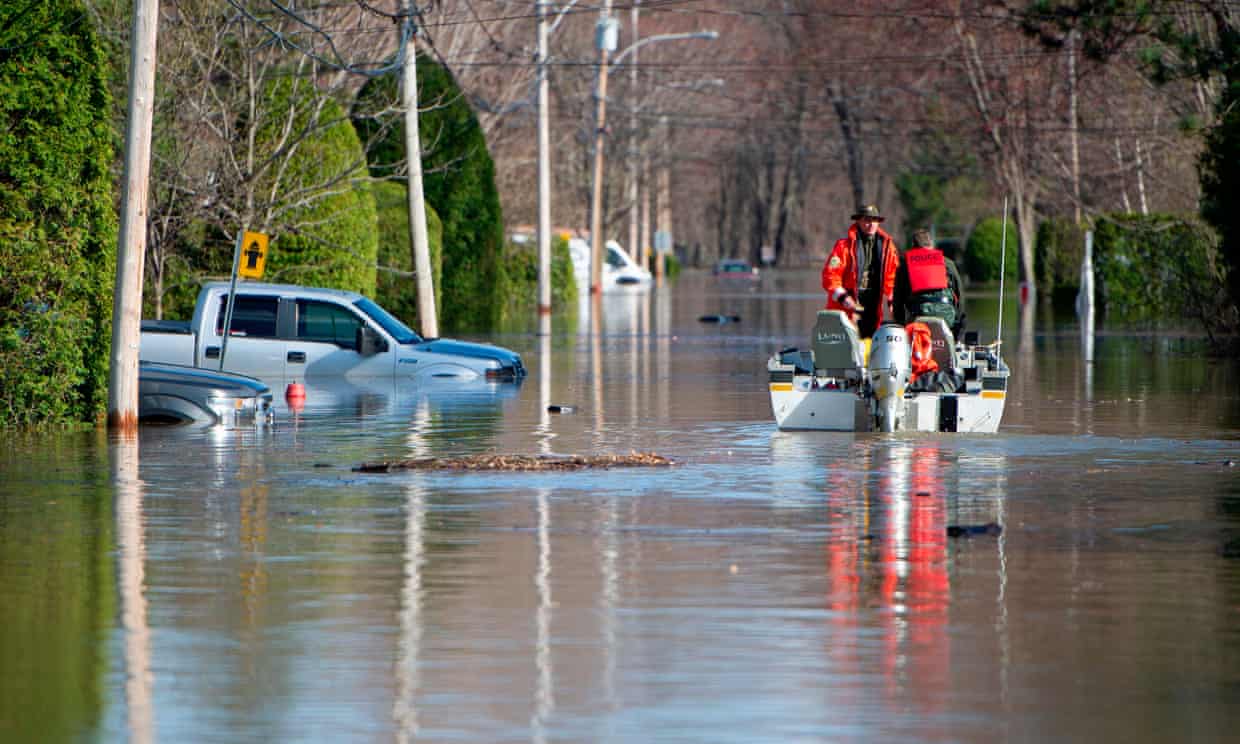
 Canadian police in a flooded street in Sainte-Marthe-sur-le-Lac in the suburbs of Montreal. Experts say the floods show Canada has not done enough to prepare for such disasters.

Canada: extreme floods show climate change effects first hand  as experts warn of further extreme weather events.
Thousands are evacuated from eastern Canada as Justin Trudeau admits urgent action necessary to improve climate preparedness.
News footage showed people boating where they once walked, homes and cars filled with muddy water, volunteers searching for lost pets. Thousands of people in eastern Canada have been forced from their homes as heavy rains and meltwater cause unprecedented flood evacuations.
One of the worst-hit areas was a Montreal suburb where more than 6,000 people were evacuated after a dike burst on Sunday. A further 3,000 people were evacuated in other parts of Quebec, and in Ontario and New Brunswick, hundreds more are waiting out the floods in hotels and shelters.
“This year’s flooding is very extreme,” said Ursule Boyer-Villemaire, an associate professor at the Université du Québec à Montréal who specializes in disaster management and climate resilience planning.
Climate change means that catastrophic flooding will only become more common, but experts say the events of the past week highlight the fact that Canada has still not done enough to prepare for such disasters. 
This is not the first time Quebec has seen large-scale flooding: in 2017, Quebec rivers reached similar levels.
The fact that two floods occurred so close together has climate preparedness experts concerned.
Rapid temperature increases in spring and huge variations in the amount of precipitation, two factors in the flooding, are related to climate change, said Laura Coristine, a biologist at the University of British Columbia.
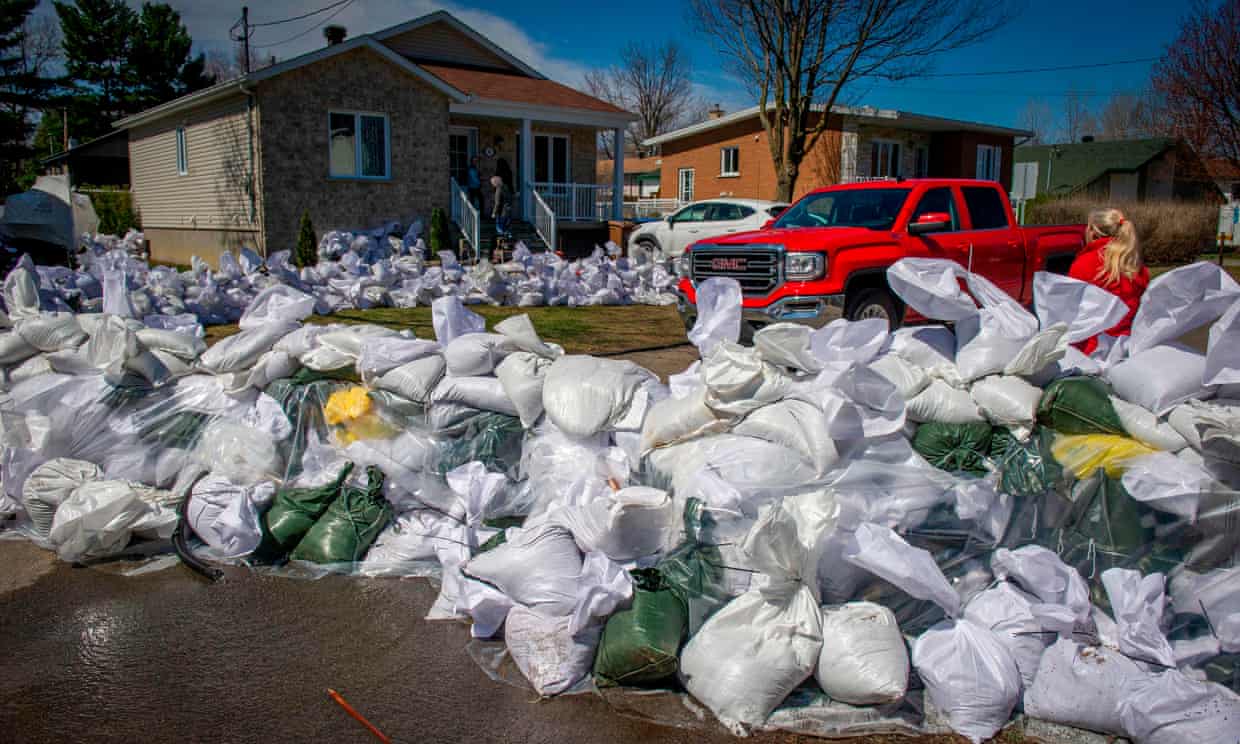
Rescue and relief operations in Sainte-Marthe-sur-le-Lac.


 But Canada has done little to prepare for flooding that is likely to become even more common as the planet continues to warm, she said. “Responding to disaster is going to be a lot more expensive than being proactive in vulnerable sites.”
Ontario’s premier, Doug Ford, whose government has fought hard against the imposition of a country-wide carbon tax aimed at curbing emissions, toured flooded areas near the Ottawa River on Friday night. According to the Canadian Press, Ford did not explicitly mention climate change but did say “something is going on and we have to be conscious of it”


Wednesday, May 8, 2019

How teaching kids about climate change can influence their conservative parents

Students attend a climate change rally in Brattleboro, Vt. A new study shows that when children learn about climate change in school, their parents become more concerned about the issue. (Kristopher Radder / Brattleboro Reformer via Associated Press) 
You could say kids are taking the lead on climate change.
Greta Thunberg, a 16-year-old Swedish activist and Nobel peace prize nominee, has barnstormed parliaments and United Nations meetings, calling on leaders to stop “behaving like children” and get serious about tackling climate change.

Following Thunberg’s lead, thousands of students around the world have started skipping school on Fridays to protest climate inaction. And in June, a group of young Americans will face off against the U.S. government in a landmark trial aimed at spurring more aggressive efforts to cut greenhouse gas emissions.
But kids can change the climate conversation at home too, according to a study published Monday in the journal Nature Climate Change.

Researchers found that teaching children about climate change in school significantly increased their parents’ concern over the issue. Notably, the effect was strongest among conservative parents — who tended to be the least worried about global warming, and whose views have historically proven difficult to influence.

Danielle Lawson, a social scientist at North Carolina State University and lead author of the study, said the results made her feel hopeful.
“Not only are we teaching kids in a way that prepares them for the future — because they are going to have to deal with the brunt of climate change — but it continues to empower their efforts to help bring all of us together to work toward solutions,” she said.

Previous experiments have shown that educating kids can spur changes in parents’ recycling habits and energy-saving behavior. Lawson and her colleagues wondered whether the same would apply for climate change.

The researchers worked with 15 teachers as they taught nearly 250 middle school students in coastal North Carolina, which will face rising sea levels and stronger storms under climate change.

In some of the classes, students worked on four activities centered on the connections between climate change and local wildlife. They also participated in a community-based project and conducted an interview with their parents about the changes in weather they had observed in their lifetimes.

Middle school students in North Carolina sample phytoplankton as part of a lesson on climate change. Researchers found that when kids learned about climate change, their parents, particularly conservative ones, became more concerned about the issue. (Danielle Lawson) 

Students in the other classes did not receive the climate change curriculum, and they served as a control group.

To see how attitudes changed as a result of the program, the researchers surveyed both students and parents at the beginning and the end of the 2016-17 and 2017-18 school years.

They found that students who completed the climate change module became more concerned about the issue than their counterparts in the control group. On a 16-point scale, their concern rose by 2.78 points, compared to 0.72 points in the control group.

The effect was even stronger among parents. Concern rose by rose 3.89 points for those whose kids learned about climate change in class, versus 1.37 points for parents whose kids did not.

But the most striking thing about the new study was that the lessons had the biggest effect among conservative parents, whose concern increased by 4.77 points, said John Cook, a climate communication researcher at George Mason University who was not involved in the study.

Surveys show that conservative Americas are least likely to be concerned about climate change, and efforts to sway them often backfire. That’s because people’s views are strongly shaped by group identity, particularly their political affiliation, Cook said: “If you change your mind on something where all of your tribe believes the same thing, you risk social alienation.”

Letting kids lead the conversation seems to make the issue less polarizing, he said.

Lawson said she thought that was because children don’t usually approach climate change from an ideological perspective. Another factor is “that unique relationship between a parent and their child, and this level of trust,” she said.

The most famous example of this involved Bob Inglis, a Republican congressman from South Carolina. After Inglis’ college-age son took a course in environmental economics, he persuaded his father to reconsider his position. In 2009, Inglis broke ranks with his party and proposed a bill to help reduce carbon emissions. (He lost his reelection bid in 2010, partly as a result of his stance on climate change, and now works to promote free-market climate solutions).
Former Congressman Bob Inglis (R-S.C.) changed his views on climate change after discussing the issue with his son. (Sony Pictures Classics) 
The researchers also found that concern increased more than average among fathers. The same was true for parents of daughters. This could be due to the fact that, compared with boys, girls expressed greater worry about climate change after the lessons. Another possible factor is that during the middle school years, girls typically communicate better than boys, the study authors said. (For reasons that remain unclear, parents of daughters started out less concerned than parents of sons.)

Experts said the program’s success had a lot to do with how teachers tackled climate change in the classroom.

“Reading a textbook and completing a worksheet are unlikely to entice students to comment on their day at the dinner table,” Martha Monroe, an expert on environmental education at the University of Florida, observed in an essay that accompanied the study.

Instead, Lawson and her team designed hands-on lessons focused on local issues. For example, one assignment involved monitoring the weather outside the school and comparing it with historical data for the region.

The students’ projects mostly focused on North Carolina’s coast. Some students helped monitor sea turtle nests, since the gender of hatching eggs depends on temperature, while others helped build oyster reefs that can protect the shore from erosion and sea-level rise.

Those activities may have translated into more parental engagement, Lawson said. “If you can get kids so excited and talking with their parents about what they are learning in schools, parents will want to learn.”

The researchers wanted the interactions to arise organically, so the curriculum did not ask students to try to change their parents’ minds. “We do not want to put that burden on small shoulders,” she said.
When teaching climate change, tackle the myths along with the facts, researchers say » 
Other educators are already using similar approaches in their climate lessons.
“To me, the key thing is having them discover it on their own,” said Rebecca Brewer, a high school biology teacher in Troy, Mich. Every year, Brewer spends a week making imitation ice cores in her freezer, which her students cut up and measure while they study scientific data on past climate changes.
“I’m not standing at the front of the room saying, ‘Climate change is real,’ ” she said. “You are going to examine the evidence and see for yourself.”

Jeremy Cook, a biology teacher in Indianapolis, Ind., (not related to John Cook) has his students investigate how climate change is bringing more invasive species to the area. “I think that’s really eye-opening for them,” he said. “It’s not just about weather patterns changing.”
Researchers and educators say these types of lessons are not about activism or advocacy. Teachers are simply giving students the facts.
“We are not telling them what to think or what to say,” Lawson said.
Students in Germany skipped class May 3 to protest climate inaction as part of a worldwide movement. (Sascha Steinbach/EPA-EFE/REX) 
Even so, the classroom has become a battleground in the fight to sway public opinion over climate change.

Conservative state legislators around the country have introduced more than a dozen bills that could make it harder to discuss climate change in classrooms, or would allow teachers to present it as an issue that’s up for debate. (It’s not.) So far, none of these measures have become law.

Today, science standards in 36 states acknowledge that climate change is real and due to human activities, but only 42% of teachers surveyed in a recent NPR/Ipsos poll said they tackled the subject in their classrooms. A third of them expressed fear of blowback from parents.

But parents overwhelmingly seem to want their kids to learn about climate change. The same poll found that 80% supported climate education in schools.
The new study demonstrates why that could have profound societal effects.
Kids don’t have a lot of monetary or political power. But if “we give them a place to have a voice,” Lawson said, “they can bring us together.

Knight Sha

Monday, May 6, 2019

Children may be their parents' best climate-change teachers, scientists find

by Sebastien Malo | @SebastienMalo | Thomson Reuters Foundation 
Monday, 6 May 2019  
Share:
https://www.facebook.com/sharer/sharer.php?u=http%3A//news.trust.org/item/20190506144457-lnoe6/
Study results suggest nationwide protests by young people urging action to tackle global warming could influence the views of adults 
By Sebastien Malo
NEW YORK, May 6 (Thomson Reuters Foundation) - Teenagers in the U.S. coastal state of North Carolina who were schooled in the basics of man-made climate change saw their parents grow more concerned about the issue, scientists said on Monday in the first study of its kind.

The results suggested nationwide protests by young people urging action to tackle global warming could influence the views of adults at home, researchers told the Thomson Reuters Foundation.

Danielle Lawson, lead author of the study published by the journal Nature Climate Change and a researcher at North Carolina State University, said the findings could "empower" ongoing efforts by students, such as the "Fridays for Future" marches.

That movement has seen school children around the world walk out of classes on Fridays, including in the United States, in protest at government inaction on climate change.
In the study, parents whose middle school-age children followed a curriculum that included learning about climate change increased their own level of concern by nearly 23 percent on average, the researchers found.

For conservative parents, the rise was significantly higher, averaging 28 percent.
The two-year experiment, involving about 240 students and nearly 300 parents, was the first to demonstrate that climate change education for children promotes parental concern, a North Carolina State University statement said.
But the results could only be generalized to North Carolina coastal counties, where the experiment took place, said Lawson.
In the research, teachers gave some students lessons on climate change, including classroom activities like mapping data and field trips to places experiencing degradation linked to global warming.

Another group did not follow that curriculum.
Parents of both groups shared their level of preoccupation about global warming in surveys administered before and after the experiment.

Brett Levy, an assistant professor of education at the New York-based University at Albany who was not involved in the study, said the results potentially spoke to dynamics at play as students skipped school to demand climate action.
"Sometimes people who participate in protests learn about the issues involved," he said. "This study suggests that young people involved in these climate demonstrations could influence the views of their parents."

Currently, 37 of 50 U.S. states, plus Washington D.C., have adopted science education guidelines that include learning about climate change as a result of human activity, said Glenn Branch, deputy director of the National Center for Science Education.
Thirteen states do not mention climate change as man-made, describe it only as a possibility, or misrepresent the scientific consensus about the phenomenon, he added. (Reporting by Sebastien Malo @sebastienmalo, Editing by Megan Rowling. Please credit the Thomson Reuters Foundation, the charitable arm of Thomson Reuters, that covers climate change, humanitarian news, women's and LGBT+ rights, human trafficking and property rights. Visit http://news.trust.org/climate)
Our Standards: The Thomson Reuters Trust Principles.

Knight Jonny

Saturday, May 4, 2019

Oh Happy Day Knight Aunt Jeannie is Back

Aunt Jeannie ,
What a wonderful and welcome  sight to see a post  from you  now we will start posting  again  , everyone here  is so very happy  you mean so much  to us   you are a  positive force in our lives and that mean a lot to us .

Aunt Jeannie  you haven't neglected the blogs  , everyone  knows  you have no control of your illness  you have to work with the  doctors   with the doctors . You have nothing to make up for , if poppa was here  he would tell you  can't control something  that you have no power over , the  thing is  to stop thinking that way  or  just  think about what mama would say  , I know what she would say  I can't say it because mama would  have  me saying on the couch  for a month 
Thank you  so much  we are  trying .
Love  from all the Knights ,
Wrote by Jenny

Thursday, May 2, 2019

Image result for graphics of knights


My dear Knights
 I have just been reading some of your great posts. They are excellent and very informative. Super job. I will get back to work also now. I have sadly neglected our blogs but I will make up for it.
Awesome job guys
Lots of love
Knight Aunt Jeannie

Restore natural forests to meet global climate goals

Date:  April 2, 2019 
Source:  University College London 
Summary:
International plans to restore forests to combat global warming are flawed and will fall far short of meeting 1.5C climate targets, according to new research. 
18-year-old naturally regenerating forest (exclusion of fire, some planting of native species) in Kibale National Park, Uganda. The forest supports elephants and many species of monkey after just 18 years. 
Credit: S. Lewis 
International plans to restore forests to combat global warming are flawed and will fall far short of meeting 1.5C climate targets, according to new research by UCL and University of Edinburgh scientists.

The study, published as a comment piece in this week's Nature, reveals that almost half (45%) of the vast areas that countries have pledged are set to become plantations of commercial trees, a move which will seriously reduce expected carbon uptake and prevent agreements to curb climate change being met.
Lead author, Professor of Global Change Science, Simon Lewis (UCL Geography) said, "There is a scandal here. To most people forest restoration means bringing back natural forests, but policy makers are calling vast monocultures 'forest restoration'. And worse, the advertised climate benefits are absent."
"Plantations are much poorer at storing carbon than natural forests. To combat climate change, natural forest restoration is clearly the most effective approach. Well-managed forests can also help to alleviate poverty in low-income regions, as well as conserve biodiversity and support the UN's Sustainable Development Goals."
To meet 1.5C requires rapid emissions cuts and removing carbon from the atmosphere. The international community is striving to restore 350 million hectares of forest, an area slightly larger than the size of India, by 2030, to do just this.
New calculations based on 43 countries' restoration pledges show that only by allowing natural forests to return would sufficient carbon be captured for new forests to play their part in meeting global climate goals.
The 43 tropical and sub-tropical countries -- where trees grow fast -- have signed up to restoration commitments, many as part of the Bonn Challenge that aims to restore 350 million hectares of forest. Together, those countries, which include Brazil, India and China, have already committed to restore 292 million hectares of forest.
The study, which is the first in the world to compile and analyse country-level commitments for forest restoration, shows that land put aside for natural forests holds 40 times more carbon than plantations and six times more than agriculture that mixes trees and crops, known as agroforestry.
Using long-term carbon sequestration rates for natural forest, plantations and agroforestry, the researchers show that restoring natural forests over 350 million hectares of land removes 42 billion tonnes of carbon by 2100, whereas using current pledges for plantations (45%), natural forests (34%) and agroforestry (21%) applied to the whole area reduce this to 16 billion tonnes of carbon by 2100, assuming that all new natural forests are protected. And if commercial monocultures were planted across 100% of the area just 1 billion tonnes of carbon is sequestered.
Countries differ vastly in their commitments. Vietnam represents the world's largest commitment of new natural forests, at 14.6 million hectares; Brazil has pledged 19 million hectares of new plantations; Nigeria has the most agroforestry, 15.7 million hectares.
Co-author Dr Charlotte Wheeler (University of Edinburgh and formerly of UCL) said, "The reason plantations are so poor at storing carbon is that they are harvested every decade or so, meaning all the carbon stored in the trees goes back into the atmosphere, as the plantation waste and the wood products -- mostly paper and chipboards -- decompose.
"Instead, restoring all 350 million hectares back to natural forests can meet the role forests need to play under Inter-governmental Panel on Climate Change emissions pathways that keep global warming to 1.5C.
"Of course, new natural forests alone are not sufficient to meet our climate goals. Emissions from fossil fuels and deforestation must also stop. Other ways to remove carbon from the atmosphere are also needed. But, no scenario has been produced that keeps climate change below dangerous levels without the large-scale restoration of natural forests."
The scientists recommend that the definition of 'forest restoration' excludes monoculture plantations, and propose four ways to increase carbon capture from today's forest restoration schemes. Firstly, increase the proportion of land being regenerated to natural forest; second, prioritise restoration in Amazonia, Borneo and the Congo Basin, which support very high biomass forest compared to drier regions; third, build on existing carbon stocks by targeting degraded forests for natural regeneration; and fourth, once natural forest is restored, protect it.
Story Source:
Materials provided by University College London. Note: Content may be edited for style and length.


Crusader Jenny , Nanook , Knight Mika  & Knight Moto

Saturday, April 20, 2019

Mosquito-borne Diseases on the Uptick—Thanks to Global Warming

Date:  March 28, 2019 
Source:  Georgetown University Medical Center 
Summary:
As many as a billion people could be newly exposed to disease-carrying mosquitoes by the end of the century because of global warming, says a new study that examines temperature changes on a monthly basis across the world. Share: 
As many as a billion people could be newly exposed to disease-carrying mosquitoes by the end of the century because of global warming, says a new study that examines temperature changes on a monthly basis across the world.

Scientists say the news is bad even in areas with only a slight risk of having a climate suited for mosquitoes, because the viruses they carry are notorious for explosive outbreaks when they show up at the right place under the right conditions.
"Climate change is the largest and most comprehensive threat to global health security," says global change biologist Colin J. Carlson, PhD, a postdoctoral fellow in Georgetown University's biology department, and co-lead author of the new study. "Mosquitoes are only a part of the challenge, but after the Zika outbreak in Brazil in 2015, we're especially worried about what comes next."
Published in the open access journal PLOS Neglected Tropical Diseases ("Global expansion and redistribution of Aedes-borne virus transmission risk with climate change"), the research team led by Sadie J. Ryan of the University of Florida and Carlson, studied what would happen if the two most common disease-carrying mosquitoes -- Aedes aegypti and Aedes albopictus -- track and move as the temperature changes over decades.
According to the World Health Organization, mosquitoes are one of the deadliest animals in the world, carrying diseases that cause millions of deaths every year. Both Aedes aegypti and Aedes albopictus can carry the dengue, chikunguyna and Zika viruses, as well as at least a dozen other emerging diseases that researchers say could be a threat in the next 50 years.
With global warming, the scientists say, almost all of the world's population could be exposed at some point in the next 50 years. As the temperature increases, they expect year-round transmissions in the tropics and seasonal risks almost everywhere else. A greater intensity of infections is also predicted.
"These diseases, which we think of as strictly tropical, have been showing up already in areas with suitable climates, such as Florida, because humans are very good at moving both bugs and their pathogens around the globe," explains Ryan, associate professor of medical geography at Florida.
"The risk of disease transmission is a serious problem, even over the next few decades," Carlson says. "Places like Europe, North America, and high elevations in the tropics that used to be too cold for the viruses will face new diseases like dengue."
More severe climate change would produce proportionally worse population exposures for the Aedes aegypti mosquito. But in areas with the worst climate increase, including west African and southeast Asia, serious reductions are expected for the Aedes albopictus mosquito, most noticeably in southeast Asia and west Africa. This mosquito carries dengue, chikunguyna and Zika.
"Understanding the geographic shifts of risks really puts this in perspective," Ryan says. "While we may see changing numbers and think we have the answer, imagine a world too hot for these mosquitoes."
"This might sound like a good news, bad news scenario but it's all bad news if we end up in the worst timeline for climate change," Carlson says. "Any scenario where a region gets too warm to transmit dengue is one where we also have different but equally severe threats in other health sectors."
The team of researchers looked at temperatures month by month to project risk through 2050 and 2080. The modeling did not predict which type of mosquito would migrate, but rather accounted for a climate where their spread would not be prevented.
"Based on what we know about mosquito movement from region to region, 50 years is a considerable long time and we expect significant spread of both types of insects, particularly Aedes aegypti, which thrive in urban environments," Carlson explains.
"This is only one study to begin understanding the fast-approaching challenges we face with global warming," Carlson says. "We have a Herculean task ahead. We need to figure out pathogen by pathogen, region by region, when problems will emerge so that we can plan a global health response."
In addition to Ryan and Carlson, study authors include Erin A. Mordecai of Stanford University, and Leah R. Johnson of Virginia Polytechnic and State University.
This work was supported by: the National Science Foundation (DEB-1518681, DEB-1641145, and DEB-1640780), Centers for Disease Control and Prevention (1U01CK000510-01), Southeastern Regional Center of Excellence in Vector-Borne Diseases: the Gateway Program, the Stanford Woods Institute for the Environment, and the Stanford Center for Innovation in Global Health.


Story Source:
Materials provided by Georgetown University Medical Center. Note: Content may be edited for style and length.

Knight Man