Thursday, May 3, 2018

The Night's Watch Oath

Image result for image of a knight keeping watch
 
"Night gathers, and now my watch begins.
It shall not end until my death.
I shall take no wife,
Hold no lands,
Father no children.
I shall wear no crowns and win no glory.
I shall live and die at my post.
I am the sword in the darkness.
I am the watcher on the walls.
I am the shield that guards the realms of men.
I pledge my life and honor to the Night's Watch,
For this night and all the nights to come."
 

2018 US summer forecast: Early tropical threat may eye South; Severe heat, drought to bake southern Plains

Accuweather           JILLIAN.MACMATH          May 3rd 2018 
The Northeast and mid-Atlantic are in for a bit of everything this summer as the weather transitions between hot, humid and stormy.

Meanwhile, the southern United States will endure persistent storms and the threat for an early tropical impact.

In the Southwest and California, building heat and dryness will pose a high risk for wildfires.

us 2018 summer forecast highlights

Summer to bring heat, humidity and severe weather to Northeast, mid-Atlantic

From heat to humidity and severe weather, the Northeast and mid-Atlantic are set to experience a bit of everything this summer.

A few hot periods will take hold throughout the summer, though it won't be persistent.

"I think there's going to be surge later in June when we really start to feel some heat here in the Northeast. But will it stick around the whole summer? I don't think that's going to happen," AccuWeather Expert Long-Range Forecaster Paul Pastelok said.

I-95 cities, including New York City, Boston and Philadelphia, are predicted to average close to normal with respect to the number of 90-degree days.

"Humidity-wise they'll have to watch out for August. That may be up a little bit," he said.

Severe weather could strike the northern mid-Atlantic states and eastern Ohio in June.

In July, that risk will shift farther northward.

Showers and thunderstorms to target the Southeast, Tennessee Valley, Gulf Coast

A barrage of showers and thunderstorms will target the Southeast, with Florida set to bounce back from severe drought conditions.

"They're going to see some more action across the peninsula throughout the summer, which is good for them. I don't see any dry conditions developing like we saw a couple of years ago," Pastelok said.

Heavier storms will pose a risk for flooding with the Tennessee Valley and central Gulf coast facing the greatest threat.

Meanwhile, the entire region will be at risk for an early tropical impact.

"The last several years we've seen early tropical hits. I don't see anything against that this year. Whereabouts? That's a tough call. Anywhere is possible along the Gulf coast this year," Pastelok said.

If a tropical system does impact the region, it's more likely to be a tropical storm which would pose a greater risk for flooding rainfall, he said.

Severe weather to threaten the western Ohio Valley, Midwest, central/northern Plains

Short-term periods of high heat will blast the region in June, though temperatures will bounce up and down throughout the summer.

Severe weather will also target the first month of the season.

"June, I think, will be the month for the severe weather in the northern Plains," Pastelok said. "It could linger a bit into July, but it will take a break before coming back in August."

Stifling heat, drought to grip the southern Plains

Severe drought is predicted to continue across the southwestern Plains as intense heat dominates the summer.

June could end up being one of the top-five hottest on record for the region.

"Places like Dallas, Amarillo, Oklahoma City, those places are going to record above-normal temperatures and below-normal precipitation this summer," Pastelok said.

The forecast could spell bad news for cattle farmers and consumers alike.

"The Plains drought could have an effect on agriculture and grazing for cattle," Pastelok said. "The grass is not going to grow as much, so farmers are going to end up spending more on feed."

High fire threat for the Southwest, California as heat and dryness build

Heat and drought will also stretch into the Southwest and California.

The fire threat in both of places will arrive early then remain high for a good part of the summer before rainfall increases into July and August.

Flash flooding is possible as precipitation increases for the interior Southwest and the central Rockies around the midpoint or latter half of the season.

Typical summer to transpire in Northwest, Rockies

Following a typical pattern for the Northwest and Rockies, late spring and early summer will remain mostly wet and cool.

The transition to warmer and drier summer weather won't arrive until later in the season.

As the warmth increases in mid-July and August, drought conditions may develop east of the Cascades.

This could result in the threat for fires from late summer and into the fall season.
Thanx   Jillian  MacMath
Knight Sha C .

Monday, April 30, 2018

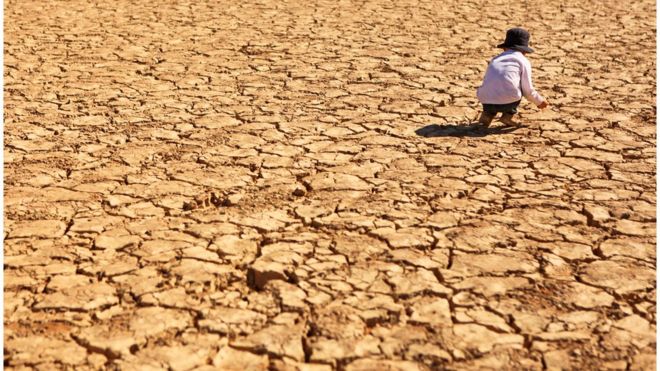
UN Climate Stalemate Frustrates Poor and Drought Ridden Countries


drought
               Poorer nations are concerned that action on climate change is not fast enough to limit the impacts
Old divisions between rich and poor over money and ambition are again threatening to limit progress in UN climate negotiations. Discussions between negotiators from nearly 200 countries have resumed in Germany, aiming to flesh out the rules on the Paris climate pact. But developing countries say they are "frustrated" with the lack of leadership from the developed world. Commitments to cut carbon are still "woefully inadequate" they said.
2018 marks a critical stage in the global climate negotiations process. By the end of this year, governments will meet in Poland to finalize the so-called "rulebook" of the Paris deal, agreed in the French capital in December 2015.
This is seen as a key test.
The rules will define the ways in which every country reports on their emissions and on their carbon-cutting actions and, importantly, how they will increase these actions in the years ahead.
But while rich and poor countries united in Paris to push through the deal, significant ruptures have re-appeared in wrangles over key technical details.
The developed nations want almost all countries to share the same set of rules on how carbon emissions are measured, reported and verified. This issue, called "transparency" in the negotiations, has run into difficulties with many emerging economies arguing for more "flexibility".
According to some observers, the richer countries believe that some in the talks are trying to turn the clock back to the time when only wealthier countries had any commitments to cut carbon, while developing countries including India and China had no obligations.
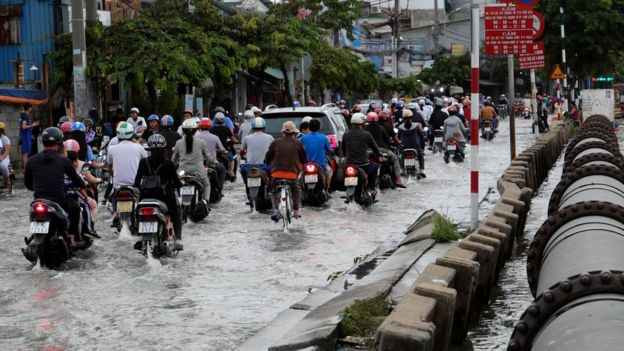

floods
Scientists predict that sea level rise caused by climate change will cause more floods such as these in Bangkok

"The EU, US, and other developed countries are worried about the slow pace of negotiations on transparency and other elements of the Paris rulebook," said Alden Meyer from the Union of Concerned Scientists.
"And what they see as the efforts of some developing countries to reintroduce bifurcation into the climate regime - an argument they thought had been settled in Paris."
The developing nations are, in turn, incensed that enthusiasm for the $100bn per year in climate finance support from the rich, due to start in 2020, has started to wane.
"It has been frustrating to hear some developed countries celebrate their climate leadership even as they fall well short of the modest commitments they have made over the years," said Thoriq Ibrahim, environment minister for the Maldives and chairman of the Alliance of Small Island States, one of the key groups of poorer nations in the talks.
"If we spent as much time working on this problem as we do congratulating ourselves for caring so deeply about it, we would be closer to an outcome worthy of a celebration.
"As it stands, we haven't mobilized nearly enough resources to tackle this problem and until developed countries match their rhetoric with action our survival will continue to hang in the balance."

Talanoa dialogue

The government of Fiji currently holds the presidency of the UN talks and has been trying to inspire greater efforts to cut greenhouse gases - they've introduced an international conversation called the Talanoa Dialogue to push countries to do more. But a UN summary of written submissions to this process reflects the frustrations.
"The scale and pace of climate action must increase dramatically, and immediately so," it says.
While the furore over the decision of US President Donald Trump to withdraw his country from the Paris agreement has died down for now, there are likely to be other flashpoints as the talks progress.
One such issue is the question of the influence of fossil fuel companies on the talks. Some campaigners want the UN to firm up the rules to ensure there are no conflicts of interest.
"The fossil fuel industry and its trade association proxies have undermined climate action for decades yet the UN continues to allow these obstructionist to pull a chair up to the table," said Jesse Bragg from Corporate Accountability.
"If we are to avert the worst effects of climate change and truly realize the promise of Paris, parties must first resolve to eject the presence of the very industry at the core of this crisis once and for all."
The talks in Bonn will run until May 10
Meanwhile people in drought ridden countries struggle to get enough food to survive.
There should be another program underway. Developed countries should provide more humanitarian aid, engineers, technicians and  equipment  and teach arid countries how to build canals, dams and irrigation ditches and how to desalinate sea water. If developing countries are helpless at  convincing the world to slow climate change, at least teach them how to deal with it.
 

Saturday, April 28, 2018

Hungry birds as climate change drives food 'mismatch'

April 23, 2018        Source: : University of Exeter 
Summary: : Warmer springs create a 'mismatch' where hungry chicks hatch too late to feast on abundant caterpillars, new research shows. 

Female Pied flycatcher. 
Credit: Tom Wallis Warmer springs create a "mismatch" where hungry chicks hatch too late to feast on abundant caterpillars, new research shows.

With continued spring warming expected due to climate change, scientists say hatching of forest birds will be "increasingly mismatched" with peaks in caterpillar numbers.
The researchers, from the RSPB and the universities of Exeter and Edinburgh, used data collected across the UK -- largely by citizen scientists -- to study spring emergence of oak tree leaves and caterpillars, and timing of nesting by three bird species: blue tits, great tits and pied flycatchers.

They also tested a theory that some bird species in southern Britain may suffer most due to a greater mismatch effect -- but they found no evidence of this.
"Forests have a short peak in caterpillar abundance, and some forest birds time their breeding so this coincides with the time when their chicks are hungriest," said Dr Malcolm Burgess, of the University of Exeter and the RSPB.
"With spring coming earlier due to climate change, leaves and caterpillars emerge earlier and birds need to breed earlier to avoid being mismatched.

"We found that the earlier the spring, the less able birds are to do this.

"The biggest mismatch was among pied flycatchers -- as migratory birds, they are not in the UK in winter and therefore are much less able to respond to earlier spring weather."
The study presents the first assessment of whether the mismatch effect is greater in southern Britain than the north.
It has been suggested that northern bird populations may be "buffered" from the effects of climate change in this way.
Dr Ally Phillimore, from the University of Edinburgh, said: "We found no evidence of north-south variation in caterpillar-bird mismatch for any of the bird species. Therefore, population declines of insectivorous birds in southern Britain do not appear to be caused by greater mismatch in the south than the north."
Dr Karl Evans, from the University of Sheffield's Department of Animal and Plant Sciences, said "Our work suggests that as springs warm in the future less food is likely to be available for the chicks of insectivorous woodland birds unless evolution changes their timing of breeding."

First leafing dates of oak trees were collected by citizen scientists coordinated by the Woodland Trust via Nature's Calendar, caterpillar abundance was monitored by collecting frass (droppings) beneath oak trees, and the timing of egg laying by blue tits, great tits and pied flycatchers were recorded by the British Trust for Ornithology's long-running Nest Record Scheme.

The research team also included the universities of Durham, Glasgow, Oxford, Stirling and Cardiff.
The paper, published in the journal Nature Ecology and Evolution, is entitled: "Tritrophic phenological match-mismatch in space and time."
Story Source:
Materials provided by University of Exeter. Note: Content may be edited for style and length.

Knight Jonny C .

Thursday, April 26, 2018