Wednesday, January 30, 2019

Trump administration 'wrecking ball' approach to science threatens public health and environment, report warns

President Donald Trump waves as he walks through the Colonnade from the Oval Office of the White House ( AP )
White House 'has ignored scientific findings on climate change, LGBTQ rights, taxes and other issues'
Valerie Strauss   
A report by the Union of Concerned Scientists says President Donald Trump and his administration have taken scores of actions that have ignored scientific findings on climate change, LGBTQ rights, taxes and other issues and that those actions are harming public health and the environment.

The report, The State of Science in the Trump Era: Damages Done, Lessons Learned, and a Path to Progress, says the organisation has documented 80 attacks on science by administration officials with limited scientific credentials and significant conflicts of interest, including direct ties to industries that agencies are supposed to regulate.

Donald Trump has repeatedly expressed opinions about climate change and other issues that contradict the best scientific research. He kept vacant the key position of chief of the Office of Science and Technology Policy – which informs federal policies on climate change, online privacy, artificial intelligence and other issues – longer than any president.

 “President Trump’s political appointees have taken a wrecking ball to science, which we all depend on,” Union of Concerned Scientists President Ken Kimmell said in a statement. “But the science community is more engaged than ever to fight back.”

The report said “the administration has compromised our nation’s ability to meet current and future public health and environmental challenges, and it continues to erode science across the federal landscape” by taking actions that include:

 “President Trump’s appointees to the Environmental Protection Agency and the Department of the Interior stand out for their glaring conflicts of interest and their hostility to the science-based mission of their agencies,” the report says. “Climate science and studies on the public health impacts of pollution have been especially targeted – demonstrating the administration’s commitment to helping politically powerful industries at the expense of the public good.”

The Union of Concerned Scientists, a nonprofit advocacy organization, said the level of political interference in science varies by agency and issue. But it noted that “both the courts and sustained pressure from scientists and their allies have prevented or restrained some of the worst abuses to date.”

Scientists and others have gone to the courts, the public-comment process and Congress to try to check the administration, and they have prevented the confirmation of some nominees and stalled some policies. The report offers a path for the new Congress, with its Democratic-led House, to safeguard scientific principles from damage by the executive branch.

“Congress has power to investigate attacks on science, defend the vital role of science in federal decision-making, and mandate increased protections for federal scientists,” the report says. “They have the power of the purse and must ensure that federal science and research remains well-funded, despite repeated attempts by the administration to cut budgets and staffing related to science. They should also demand that those nominated to lead federal agencies acknowledge and act upon the latest science.”

The report describes in detail examples of actions taken – or not – by the administration.

For example, it noted that Treasury Secretary Steven Mnuchin had promised comprehensive studies of the economic impact of the proposed Tax Cuts and Jobs Act before it became law and even said that more than 100 people “working around the clock on running scenarios” would provide evidence that the proposed $1.5 trillion tax plan would pay for itself through economic growth. No such analysis emerged, the report said, and “Treasury economists stated they were barred from conducting comprehensive analyses and that the analyses Secretary Mnuchin described did not exist.”

It said the Trump administration “repeatedly ignored, dismissed, or suppressed the science of climate change, limiting the ability of federal scientists to speak about, report on, or even study it” and has “removed, revoked, and suppressed mentions of climate change in agency documents.” Instead, it has pointed “to elements of uncertainty about the magnitude of impacts and the human causes of climate change rather than the overwhelming US and international consensus on its very significant risks and the unequivocal evidence that recent warming is primarily caused by human activities.”

An example of when scientists and other advocates successfully pushed back involved Scott Pruitt, the former EPA administrator who was forced out in July because of scandals. On his last day as administrator, he created a loophole that would have allowed a certain kind of truck to emit massive amounts of pollution, the report said. A coalition of public health groups, environmental activists, scientists and others lobbied against it and went to court. The new EPA administrator got rid of the change.

Thanx Valerie Strauss             Washington Post

Knight  Jonny

Monday, January 28, 2019

If all the ice melted


If we keep burning fossil fuels indefinitely, global warming will eventually melt all the ice at the poles and on mountaintops, raising sea level by 216 feet.
By releasing carbon dioxide and other heat-trapping gases into the atmosphere, we have warmed the Earth by more than a full degree Fahrenheit over the past century and raised sea level by about eight inches. Even if we stopped burning all fossil fuels tomorrow, the existing greenhouse gases would continue to warm the Earth for centuries. We have irreversibly committed future generations to a hotter world and rising seas. 

 The concentration of carbon dioxide in the atmosphere has surpassed 400 parts per million, the highest since three million years ago. Sea levels then may have been as much as 65 feet above today’s; the Northern Hemisphere was largely ice free year-round. It would take centuries for the oceans to reach such catastrophic heights again, and much depends on whether we manage to limit future greenhouse gas emissions. In the short term scientists are still uncertain about how fast and how high seas will rise. Estimates have repeatedly been too conservative.

Global warming affects sea level in two ways. About a third of its current rise comes from thermal expansion—from the fact that water grows in volume as it warms. The rest comes from the melting of ice on land. So far it’s been mostly mountain glaciers, but the big concern for the future is the giant ice sheets in Greenland and Antarctica. 12 years ago the Intergovernmental Panel on Climate Change (IPCC) issued a report predicting a maximum of 23 inches of sea-level rise by the end of this century. But that report intentionally omitted the possibility that the ice sheets might flow even more rapidly into the sea, on the grounds that the physics of that process was poorly understood.

Climate scientists now estimate that Greenland and Antarctica combined have lost on average about 50 cubic miles of ice each year since 1992—roughly 200 billion metric tons of ice annually. Many think sea level will be at least three feet higher than today by 2100. Even that figure might be too low. Coastal cities face a twofold threat: Inexorably rising oceans will gradually inundate low-lying areas, and higher seas will extend the ruinous reach of storm surges. The threat will never go away; it will only worsen.
Using a conservative prediction of a half meter (20 inches) of sea-level rise, the Organization for Economic Co-operation and Development estimates that by 2070, 150 million people in the world’s large port cities will be at risk from coastal flooding, along with $35 trillion worth of property—an amount that will equal 9 percent of the global GDP. How will they cope?

Debris from throughout the ages


Have human beings permanently changed the planet? That seemingly simple question has sparked a new battle between geologists and environmental advocates over what to call the time period we live in.
According to the International Union of Geological Sciences (IUGS), the professional organization in charge of defining Earth’s time scale, we are officially in the Holocene ( which means - “entirely recent”) epoch, which began 11,700 years ago after the last major ice age.
But that label is outdated, some experts say. They argue for “Anthropocene”—from anthropo, for “man,” and cene, for “new”—because human-kind has caused mass extinctions of plant and animal species, polluted the oceans and altered the atmosphere, among other lasting impacts.
Anthropocene has become an environmental buzzword ever since the atmospheric chemist and Nobel laureate Paul Crutzen popularized it in 2000. This year, the word has picked up velocity in elite science circles: It appeared in nearly 200 peer-reviewed articles, the publisher Elsevier has launched a new aca­demic journal titled Anthropocene and the IUGS convened a group of scholars to decide  whether to officially declare that the Holocene is over and the Anthropocene has begun. What did they decide?? They decided that we are indeed in the 'Anthropocene Age'.

Tuesday, January 22, 2019

Magnetic North's erratic behavior forces update to global navigation system

 By    Brooks Hays          
Earth's magnetic field is behaving erratically. The planet's shifting magnetic poles could cause navigational problems. Photo by Shutterstock

Jan. 14 (UPI) -- Magnetic North is shifting rapidly, throwing off the World Magnetic Model that powers a variety of global navigational systems.

Scientists were originally scheduled to release an updated model this week -- a fix for the accumulating anomalies -- but due to the government shutdown, the update's release has been delayed until the end of the month.

Scientists with the British Geological Survey and the U.S. National Oceanic and Atmospheric Administration update the World Magnetic Model every five years. The last full update came in 2015. Shortly afterwards, a portion of Earth's magnetic field briefly shifted deep beneath northern South America.

Over the last few years, the erratic behavior continued.

"Since late 2014 the core field has varied in an unpredicted, and currently unpredictable, manner," British Geological Survey scientist Will Brown wrote in a blog update. "This led to the WMM becoming less accurate, particularly at high northern latitudes."

Most recently, Magnetic North migrated rapidly into Siberia. According to a recent report by Nature, scientists realized the model was in serious trouble early last year.

"Researchers from NOAA and the British Geological Survey in Edinburgh had been doing their annual check of how well the model was capturing all the variations in Earth's magnetic field," Alexandra Witze reported. "They realized that it was so inaccurate that it was about to exceed the acceptable limit for navigational errors."

In December, NOAA issued a partial update to patch up the most glaring errors, but the model remains inaccurate. The forthcoming update is desperately needed.

Scientists think the magnetic field's erratic behavior is explained by changes in the flow of iron inside Earth's outer core. But it's also possible Earth's magnetic poles are on the verge of reversing.

The planet's magnetic poles flip every 200,000 to 300,000 years, but an attempted flip 40,000 years ago failed. Earth's poles haven't flipped in nearly 800,000 years. In other words, they're due.

RELATED Citizen scientists help solve mystery of the purple sky
Though powered by the swirl of iron and nickel in Earth's molten core, a variety of factors can influence the planet's magnetic field.

"The magnetic poles drift, the field strengthens and weakens, and the immense magnetic field of the sun, carried by the solar wind, constantly batters at it from the outside," according to Brown. "The effect of all these changes vary depending on when and where you are on, under, or above the Earth's surface."

Researchers with NOAA and BGS hope to gain a better understanding of what's driving the magnetic field's erratic behavior before their next World Magnetic Model update, scheduled to be completed by the end of the year.
Thanx  Brooks  Hays
Crusader  Jenny , Nanook . Knight  Mika  & Knight  Moto

Tree Huggers Unite

 
Loving trees and everything they represent …. and appreciating what they give us, opens our minds and hearts to other wonderful works of nature. So go hug a tree and it will hug you back
 (in a manner of speaking).  However, If it actually hugs you back, or speaks to you … run like heck.

Monday, January 21, 2019

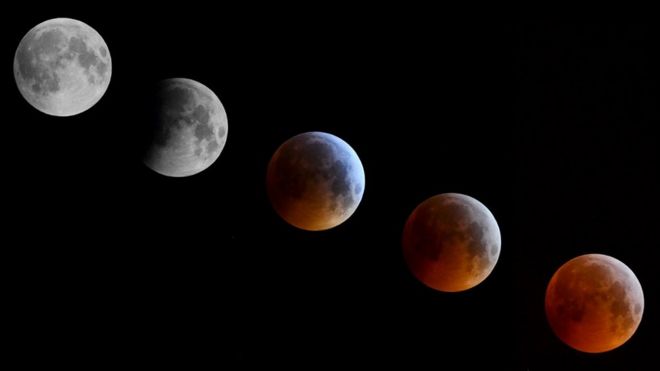
Super Blood Wolf Moon ... Skywatcher's delight

21 January Lunar eclipse
 
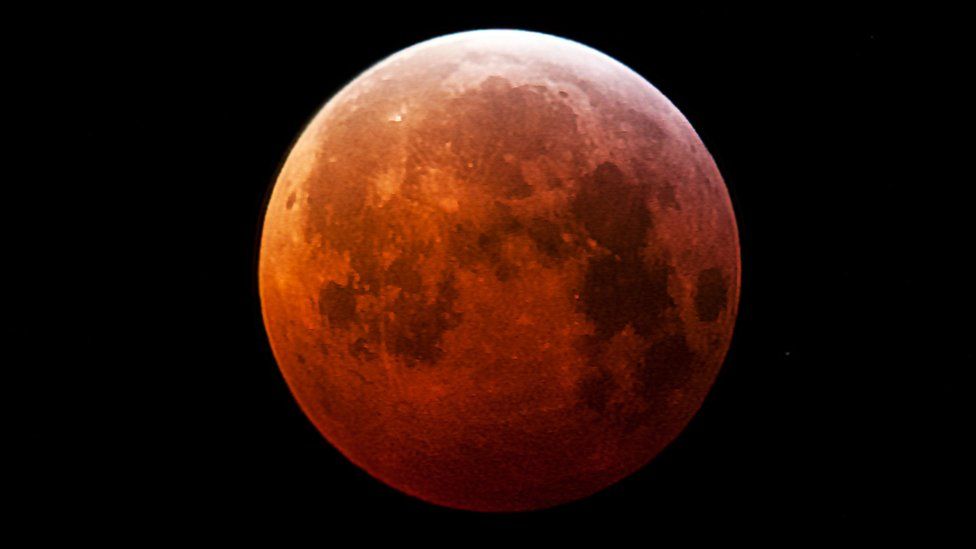
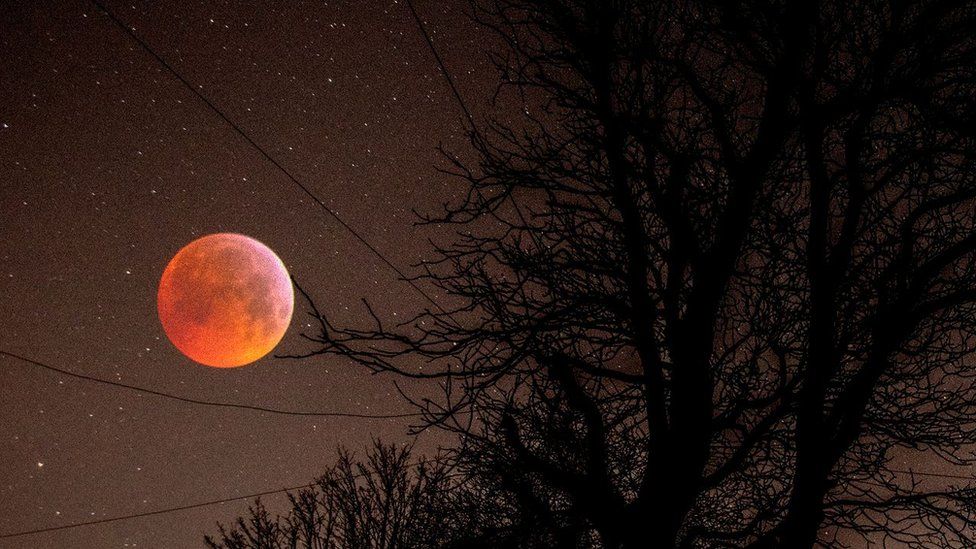
A lunar eclipse, which some are referring to as a "super blood wolf moon", has delighted skywatchers around the world.
During the spectacular event, the Earth's natural satellite turns a striking shade of red.
The entire eclipse was visible from North and South America, as well as parts of western Europe and north Africa.

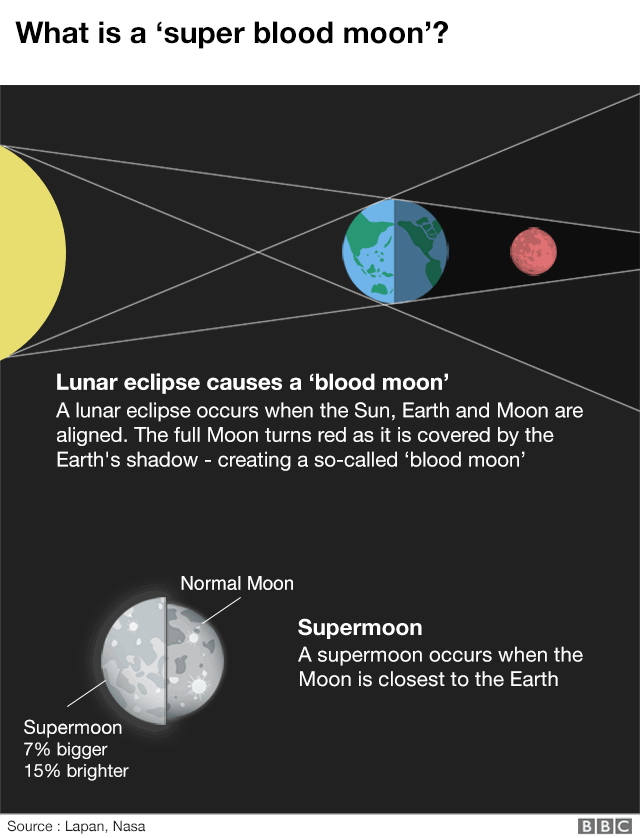
What is a total lunar eclipse?

This kind of eclipse occurs when the Earth passes precisely between the Sun and the Moon.

Super blood wolf moon
In this situation, the Sun is behind the Earth, and the Moon moves into the Earth's shadow.
 
Blood moon explanation graphic
 
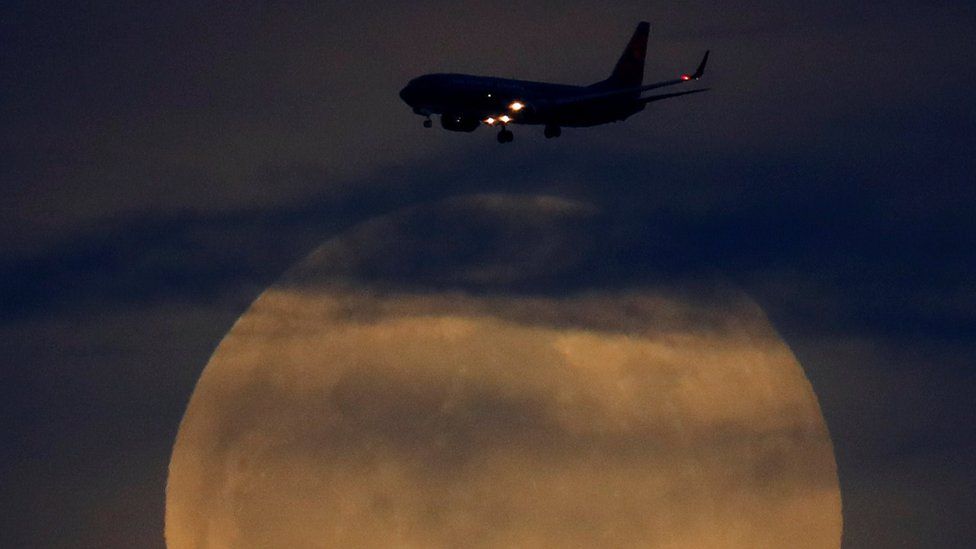
A full moon rises between clouds as a landing commercial jet approaches the airport before the start of a total lunar eclipse that is called a "Super Blood Wolf Moon" in San Diego, California

Will the moon appear red?

Yes. Some commentators are referring to the event as a "super blood wolf moon". The "super" part comes from the fact that the Moon will be near its closest approach to the Earth - when it will be marginally bigger in the sky than usual. The "wolf" part comes from the name given to full moons in January - "wolf moons".
Walter Freeman, an assistant teaching professor at Syracuse University in New York state, said: "A little bit of sunlight is refracted by the Earth's atmosphere and reaches the Moon, bending around the edges of the Earth. This small amount of red light still illuminates the Moon enough for us to see.

The moon seen beside a quadriga on top of the Cinquantenaire arch in Brussels

The moon seen beside a quadriga on top of the Cinquantenaire arch in Brussels
 
Super blood wolf moon through trees at night

Where was it visible?

The eclipse began at 02:35 GMT on Monday and ended at 07:49 GMT, but the point of greatest eclipse occurred at 05:12 GMT.
In the UK, the Moon was above the horizon throughout the eclipse, though from the extreme south-east of England the Sun had risen as the eclipse ended
This eclipse was also visible in north-western France, north-western Spain, Portugal, a small part of west Africa, almost the whole of North and South America, the eastern Pacific, and the north-eastern tip of Russia.

Was it safe to look at?

While solar eclipses are dangerous to view directly, the light from lunar eclipses is much fainter and so is completely safe to view without special equipment.

Why is it significant?

The event was the last chance for skywatchers to see a total lunar eclipse in its entirety until 2029 - weather permitting.

Super blood wolf moon and church

Thanx to BBC

Friday, January 18, 2019

Global warming is fueling stronger ocean waves

"For the first time, we have identified a global signal of the effect of global warming in wave climate," said researcher Borja G. Reguero.
Brook Hayes        Jan  14 , 2019
Global wave energy is increasing as ocean temperatures rise. Photo by UPI/Shutterstock/Ethan Daniels

Jan. 14 (UPI) -- Waves around the world are getting stronger as a result of the energy provided by global warming.

According to a new paper published in the journal Nature, scientists have discovered a correlation between increases in ocean temperatures and wave energy.

Climate scientists have mostly focused on the effects of climate change on ocean temperatures, ocean currents, sea level rise and melting sea ice, but new research suggests surface-level wind speeds and wave heights are changing as ocean temperatures increase.

"For the first time, we have identified a global signal of the effect of global warming in wave climate," Borja G. Reguero, researcher in the Institute of Marine Sciences at the University of California, Santa Cruz, said in a news release. "In fact, wave power has increased globally by 0.4 percent per year since 1948, and this increase is correlated with the increasing sea-surface temperatures, both globally and by ocean regions."

The influence of global warming on global wave power is strong enough that scientists think the measurement could be used as an important indicator of climate change's influence on ocean and atmospheric systems -- on par with indicators like carbon dioxide concentration and the global sea level rise.

Wave energy is the most powerful driver of coastal change and flooding, affecting where and how coastal communities build infrastructure -- harbors, levees and breakwaters. Increases in global wave power can amplify the impacts of sea level rise on coastal communities.

"Our results indicate that risk analysis neglecting the changes in wave power and having sea level rise as the only driver may underestimate the consequences of climate change and result in insufficient or maladaptation," said Fernando J. Méndez, associate professor at the University of Cantabria.
Thank   Brook  Hayes
Knight  Sha