Monday, May 25, 2020

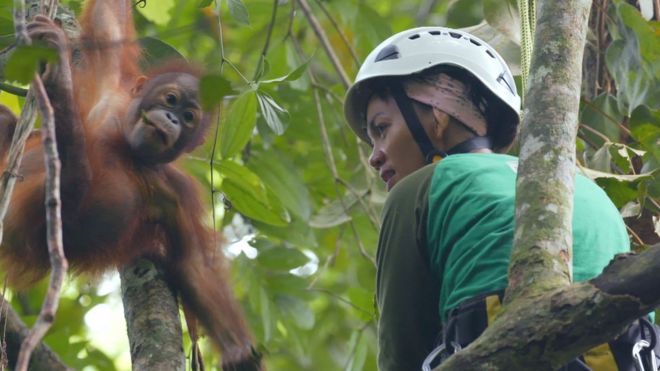
Humans teaching Orangutans to climb trees

An orphan orangutan climbs high in the treetops with his caregiver     
 An orphan orangutan climbs high in the treetops with his caregiver
 
Orangutans are hunted for meat or sold into the illegal wildlife trade. One dedicated doctor saves and rehabilitates captured orangutans and raises orphaned babies.
While much of the world is in lockdown, youngsters in one very unusual classroom are still having lessons. At a forest school in Borneo, baby orangutans learn tree-climbing skills from their human surrogate parents.
The orphans spend 12 hours a day in the forest, preparing for a new life in the wild. With human contact routinely kept to a minimum, life goes on much as before for the animals, says Dr Signe Preuschoft, leader of ape programs for the charity Four Paws, which runs the rehabilitation centre in East Kalimantan (Borneo Indonesia).
As a precaution, the staff now have temperature checks, wear facemasks and change into uniforms on site.The pandemic has disrupted many conservation programs around the world but Dr Preuschoft says it also offers an opportunity to bring positive change.
"There are great opportunities here to protect wildlife better from illegal wildlife trade and from (consumption of) bushmeat," she says. "It's very much about education."
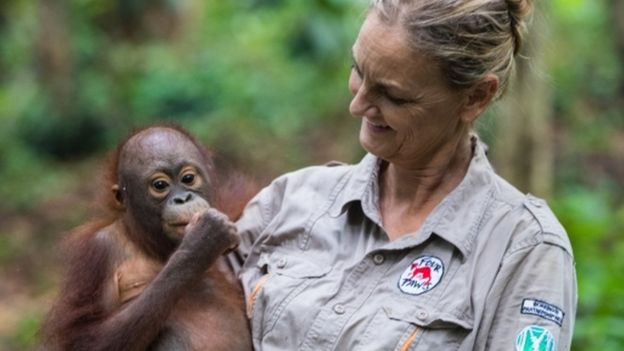
 
Dr Preuschoft and orangutan
Dr Preuschoft with an orphaned orangutan
 
The young orphaned apes climb high into the treetops with their caregivers to help them acquire the skills they would have learned from their mothers in the wild. They would otherwise spend more time on the ground than is natural for a species that feeds, lives and sleeps in the canopies of trees.
Baby orangutans have a huge advantage when it comes to climbing, as they can hold on "like an octopus", says Dr Preuschoft.
"I think the orangutans were really completely thrilled when they realised that they could actually be high in the tree canopy together with one of their moms," she adds.
As soon as the rescued orangutans have moved out of quarantine, they spend long hours in the forest in as natural an environment as possible. They are taught essential forest survival skills in a large forested area between the cities of Balikpapan and Samarinda.
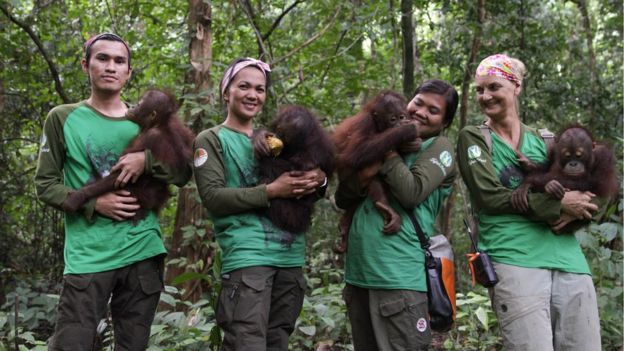
 
Dr Signe Preuschoft and her team
Dr Signe Preuschoft and her team are passionate about rehabilitating orphaned baby orangutans

The aim is to provide sanctuary to illegally captured or directly threatened orangutans, as well as to rehabilitate orphaned orangutans, with the goal of releasing them back into the wild.
Only about 50,000 Bornean orangutans are left in the world, with numbers plummeting over the last 70 years. Loss of rainforest to oil palm plantations or coal mining leads orangutans into conflict with humans.
Orphans are snatched from their dead mothers and are sold or held illegally as pets. Why do we wait until a species is seriously endangered before we do anything to help them?


Tuesday, May 5, 2020

History Made As Ocean Cleanup Successfully Collects First Plastic From The Great Pacific Garbage Patch

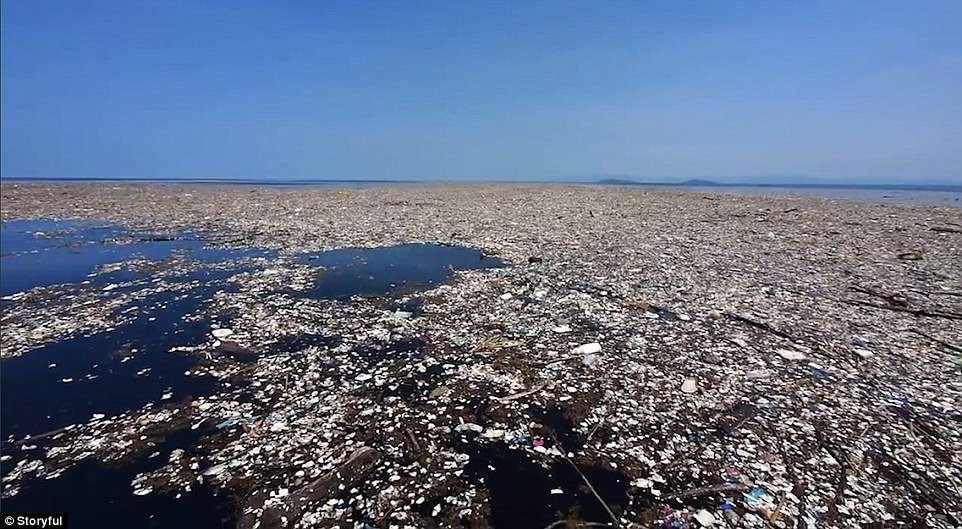
The Great Pacific Garbage Patch
Pacific garbage patch


Cleanup is underway


In the Pacific ocean, North East of Hawaii, there exists a giant whirlpool of plastic debris that’s accumulated by the ocean currents. It’s referred to as the North Pacific Gyre, but also commonly referred to as “The Great Pacific Garbage Patch.” It’s one of the largest ecosystems on Earth, made up of millions of square kilometers. The Great Garbage Patch is approximately the size of Queensland, Australia, where an enormous amount of plastic is spread throughout the ocean.

Plastic pollution in our oceans is obviously one of the biggest issues our planet faces today. We must clean up our planet, and we must do it now. Plastic pollution has also created microplastic pollution ( very tiny particles of plastic). Microplastics are a huge problem, and microplastic contamination is now extremely widespread. More than five trillion pieces of plastic, collectively weighing nearly 269,000 tons, are floating in the world’s oceans. Data collected by scientists from the US, France, Chile, Australia and New Zealand suggests a minimum of 5.25 tons of plastic particles exists in the oceans, most of them being microplastics measuring less than 5mm.

All living beings within the ocean are also suffering from microplastic pollution. The good news is  that the contraption in the video is also harvesting microplastics. This is why it was so encouraging when I came across news showing that after one year of testing, The Ocean Cleanup organization announced this week that their System 001/B vessel is capturing and collecting plastic debris in this area of the ocean, and doing so successfully. The system uses natural forces of the ocean to catch the plastic in the Great Pacific Garbage Patch, a principle behind the cleanup that was first presented by the creator, Boyan Slat back in October 2012.

The patch, again, is very large, representing a huge piece of trash that’s drifting halfway between California and Hawaii.
 
After discovering the patch in the 90s, scientists said it would take thousands of years to clean it up—but Slat quickly made a name for himself after he presented a TEDx talk in which he claimed that he could do it in less than ten, if he could get his special machinery built.
Though his claim caused many skeptics to raise their eyebrows, Slat dropped out of college so he could bring his plans to life. In addition to crowdfunding $2.2 million for his idea, he garnered millions more dollars through interested investors.
 
Now, the System 001/B vessel—which launched from Vancouver in June—is The Ocean Cleanup’s second attempt to prove its concept of collecting garbage from the Great Pacific Garbage Patch. In addition to collecting plainly visible pieces of plastic debris, as well as much larger ghost nets associated with commercial fishing, System 001/B has also successfully captured microplastics as small as 1 millimeter—a feat which the organization was pleasantly surprised to achieve.
 
It’s great to see so many young people with the desire to change the world. Often when one has such a desire, it’s easy to feel like you’re not making an impact. There are many avenues one can take to help create a positive change on this planet in the form of action, awareness, or other avenues that exist. The more people with the desire to see change and with the desire to help, the better our world will continue to be.
Yes, there is opposition from powerful people with enormous resources, who have been partly responsible for the pollution and resulting climate change we have experienced. Imagine what these people, the financial elite, with all of the billions/trillions they have, could do, if they wanted to be a positive force in saving our planet.

Tuesday, April 28, 2020

An oasis of cleaner skies and clearer water ... but it's temporary

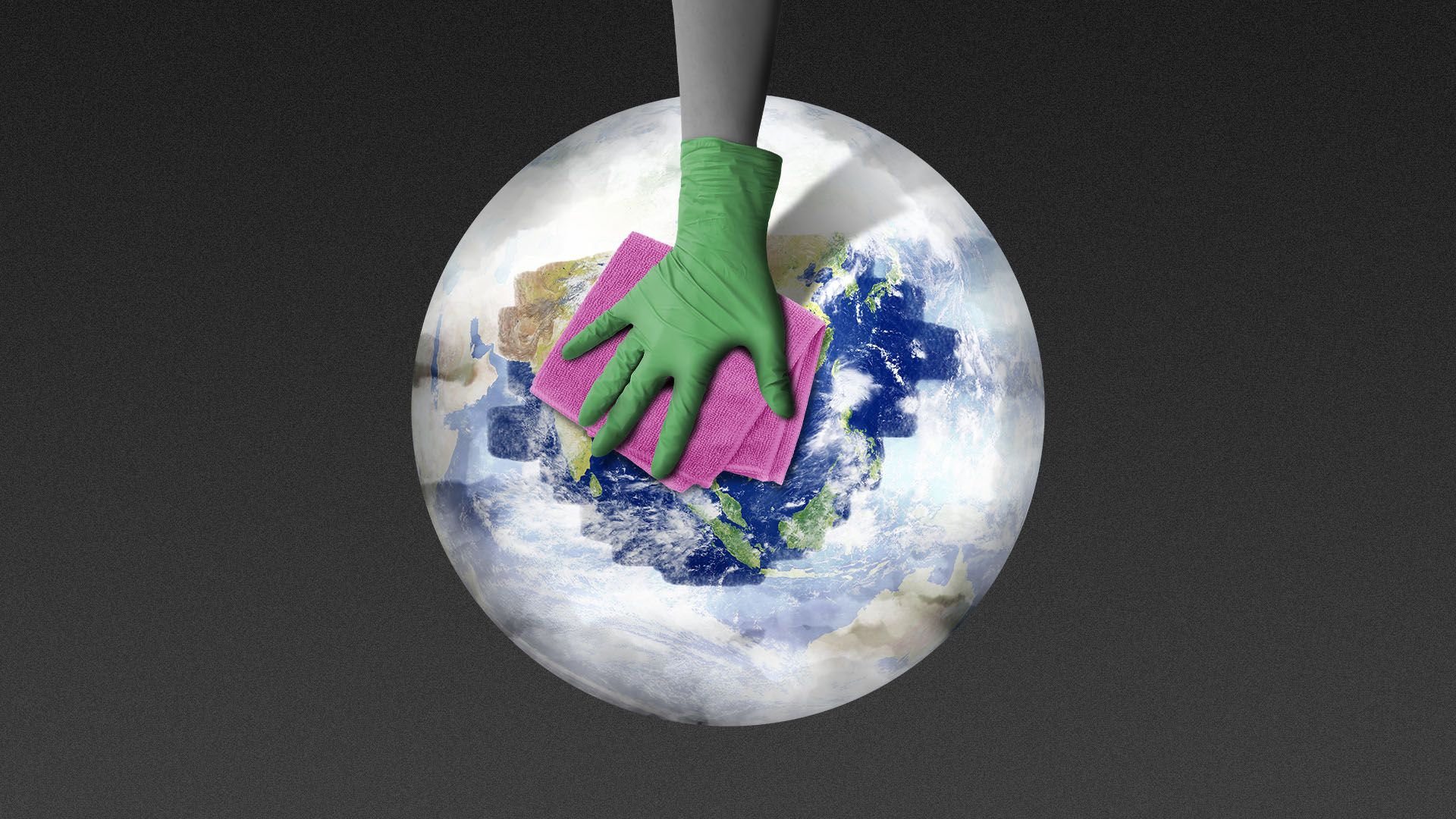
Illustration of a hand with a medical glove wiping a clear spot on a smoggy Earth.
Illustration: Sarah Grillo/Axios

The pandemic is creating a temporary oasis of cleaner skies and waters, but at immense health and economic costs.  
 
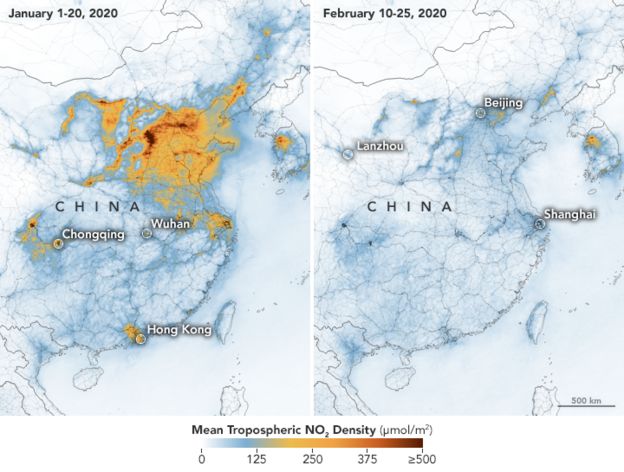
A map released by Nasa shows how air pollution levels have reduced in China this year
Carbon emissions over China before and during pandemic

The skies are clearing of pollution, wildlife is returning to newly clear waters, a host of flights have been scrapped and crude oil is so worthless that the industry would have to pay you to take it off their hands – a few months ago, environmentalists could only dream of such a scenario as the 50th anniversary of Earth Day hove into view.
But this disorientingly green new reality is causing little cheer given the reason is the coronavirus pandemic that has ravaged much of the world.
“This isn’t the way we would’ve wanted things to happen, God no,” said Gina McCarthy, former head of the US Environmental Protection Agency in the Obama administration. “This is just a disaster that pointed out the underlying challenges we face. It’s not something to celebrate.”
Wednesday’s annual Earth Day event, this year largely taking place online, comes as public health restrictions to prevent the spread of Covid-19 have resulted in a sharp dip in air pollution across China, Europe and the US, with carbon emissions from the burning of fossil fuels heading for a record 5% annual drop.

The waters of Venice are now clear, lions lounge on roads normally frequented by safari-goers in South Africa and bears and coyotes wander around empty accommodation in Yosemite national park in California.
Meanwhile, nearly eight in 10 flights globally have been canceled, with many planes in the US carrying just a handful of people. The oil industry, a key driver of the climate crisis and direct environmental disaster, is in turmoil, with a barrel of crude hitting an unprecedented minus-$40 on Monday.
These would perhaps be the sort of outcomes seen had stringent environmental policies been put in place in the wake of the first Earth Day in 1970, which saw 20 million Americans rally in support of anti-pollution measures.

Instead, the pain of the Covid-19 shutdown has highlighted how ponderous the world’s response has been – the expected cut in emissions, for example, is still less than what scientists say is needed every year this decade to avoid disastrous climate impacts for much of the world.
“It’s the worst possible way to experience environment improvement and it has also shown us the size of the task,” said Michael Gerrard, an environmental law expert at Columbia University.
How people react to the return of normalcy after the pandemic will help define the crises racking the environment, according to Gerrard. “A key question will be do we have a green recovery, do we seize the opportunity to create jobs in renewable energy and in making coastlines more resilient to climate change?” he said. “The current US president clearly has no inclination to do this.”
McCarthy, now head of the Natural Resources Defense Council, noted that some Indian people were seeing the Himalayas for the first time due to the veil of air pollution lifting.
“You wonder if people will want to go back to what it was like before,” she said. “The pandemic has shown people will change their behavior if it’s for the health of their families. This has been the lost message on climate, that it’s a human problem, not a planetary problem. We have to show you can have a stable environment and your job, too.”
The problems in the natural world haven’t suddenly vanished – this week various researchers found that the Arctic is very likely to be free of sea ice in summers before 2050, that the bushfires that torched Australia earlier this year released more carbon than the country’s annual CO2 output and that the first quarter of 2020 was the second-warmest on record.
Donald Trump has signaled that he will try to provide a bailout to the US oil and gas industry, with $25bn already handed out by the US government to prop up airlines. In China, it’s not certain that the wildlife-packed “wet markets” where Covid-19 is believed to have originated will be shut down.

Conservationists warn that returning the world to its pre-pandemic settings will quickly wipe out any environmental benefits of the shutdown.
“It’s a serious wake-up call,” said Thomas Lovejoy, an ecologist who coined the term “biological diversity”. “We bulldoze into the last remaining places in nature and then are surprised when something like this happens. We have done this to ourselves by our continual intrusion into nature. We have to re-chart our course.”

Monday, April 13, 2020

Super Plants May Slow Global Warming


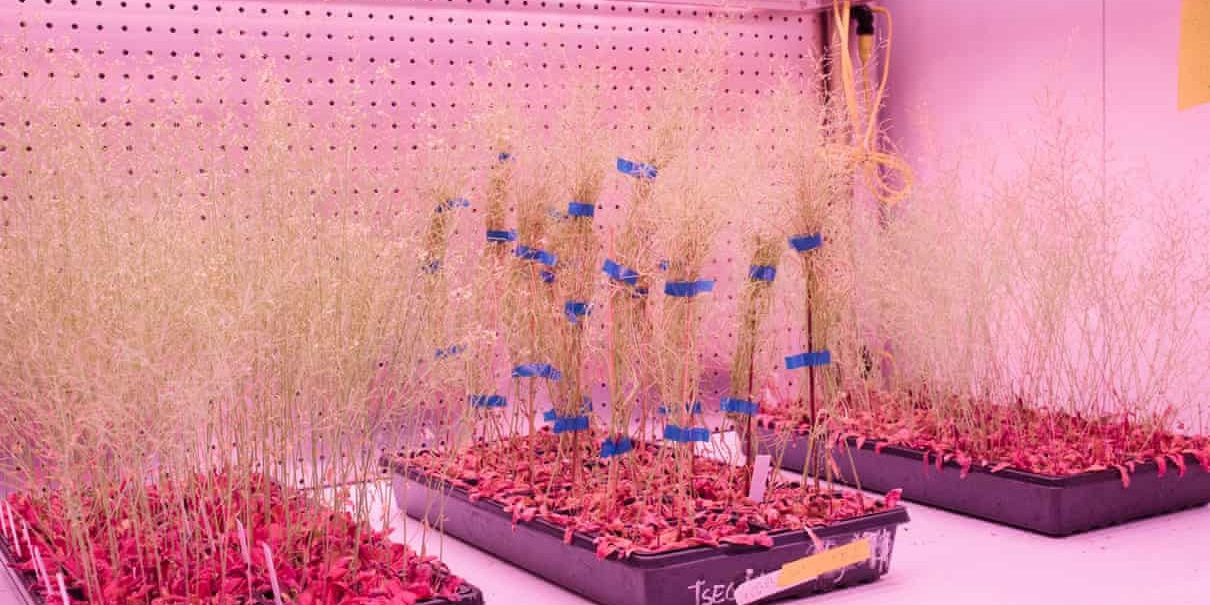
Each year, we produce 18 more gigatons of CO2 than what the Earth can handle. Another observation, each year, plants suck up approximately 65 gigatons of CO2 in the air, and store it in their leaves, stems, roots. Doctor Joanne Chory develops, in her laboratory, super plants able to suck up even more CO2. 
 

Suberin, Cork and CO2 

 Suberin can be found in plants, in their stem or roots. It allows the plant a better adaptation to its environment and to maximize the absorption of nutrients and water. Cork is also mainly composed of suberin. Besides, cork is known for its ability to keep CO2 prisoner. Suberin thus plays an important role in the storage of carbon in the soil by plants. 

Ideal Plants: The Harnessing Plants Initiative

“Plants evolved to suck up CO2 and they’re really good at it. And they concentrate it, which no machine can do, and they make it into useful materials, like sugar. They suck up all the CO2, they fix it, then it goes back up into the atmosphere.” - Dr Joanne Chory
 Dr Chory's idea is to do what nature already does, but with a greater impact: creating super plants more absorbent in CO2 and more resistant to climate change. The principle consists of splicing the genes of plants like beans, corn and cotton with a new compound allowing them to better absorb carbon in the air. As a result, the roots of the super plant transfer the carbon absorbed from the leaves to the roots and finally in the soil. 

 With these super plants, Dr Joanne Chory only improves on what nature does. However, she is aware that genetic modification is often misunderstood and reduced to a negative vision of GMO. Nevertheless, farmers practise genetic modification for centuries. Corn perfectly illustrates this point. Dr Chory also reminds that there is no foreign genetic material in the super plants, unlike in most of GMOs. 
For now, Dr Chory and her team have to test the plants on the Mississippi shores in Louisiana. The SALK Institute also negotiates with seed companies to democratize the access to super plant seeds, so it will be available for any farmer in the world. 
Doctor Joanne Chory is director of the Plant Molecular and Cellular Biology Laboratory at the Salk Institute for Biological Studies. 

The window for slowing global warming is getting smaller. In another ten to twelve years we will reach the tipping point, from which there is no return. That means the planet will continue to warm, regardless of what we do at that time. Wake-up EARTH!

Monday, September 23, 2019

Go! Go! Greta


Teenage climate change activist Greta Thunberg on Monday opened the United Nations Climate Action Summit with an angry condemnation of world leaders for failing to take strong measures to combat climate change.

Thunberg, visibly emotional, said in shaky but stern remarks at the opening of the summit that the generations that have polluted the most have burdened her and her generation with the extreme impacts of climate change.

"This is all wrong. I shouldn't be up here. I should be back in school on the other side of the ocean yet you all come to us young people for hope. How dare you," she said.

"You have stolen my dreams and my childhood with your empty words," Thunberg said.

Days after millions of young people took to the streets worldwide to demand emergency action on climate change, leaders gathered for the annual United Nations General Assembly were to try to inject fresh momentum into stalling efforts to curb carbon emissions.
 
 Greta Thunberg is a hero. She has taken on the world leaders single-handedly. She has shamed them and made their attitude seem ignorant, crass and downright criminal. She may stir enough passion and conscience to save this planet. Bless her.

Friday, September 20, 2019

Sea Turtles are gravely endangered


WWF is working to save habitats of species across the globe and to stop illegal wildlife trade. Please visit WWFnow.org to become a monthly donor today. Monthly donors provide resources we need to support WWF’s global conservation work.