Where would all those people go?

Wednesday, February 15, 2017

Sunday, February 12, 2017
Could a $500bn plan to refreeze the Arctic before all the ice melts away, really work?
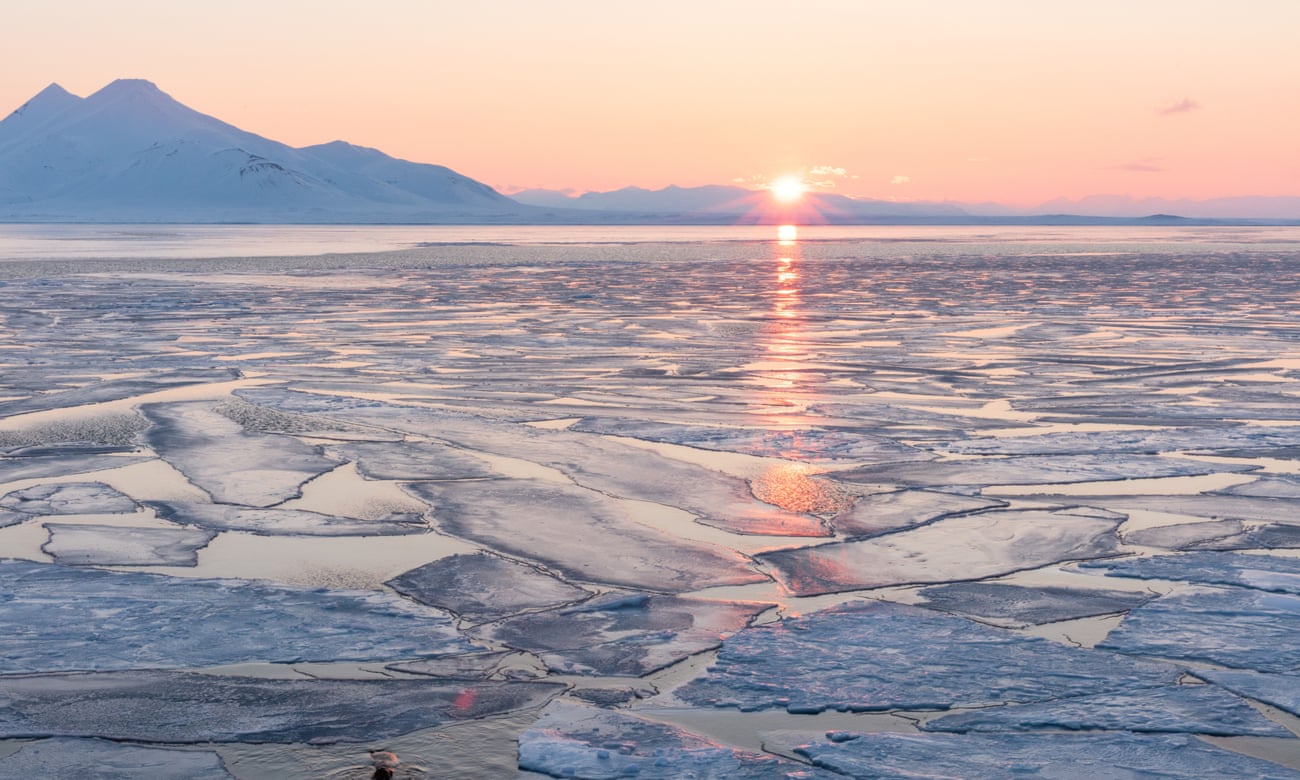
The Arctic under the midnight sun ... a kingdom of ice, almost gone
The pumps could add an extra metre of sea ice to the Arctic’s current layer, Desch argues. The current cap rarely exceeds 2-3 metres in thickness and is being eroded constantly as the planet succumbs to climate change.
“Thicker ice would mean longer-lasting ice. In turn, that would mean the danger of all sea ice disappearing from the Arctic in summer would be reduced significantly,” Desch told the Observer.
Desch and his team have put forward the scheme in a paper that has just been published in Earth’s Future, the journal of the American Geophysical Union, and have worked out a price tag for the project: $500bn.
It is an astonishing sum. However, it is the kind of outlay that may become necessary if we want to halt the calamity that faces the Arctic, says Desch, who, like many other scientists, has become alarmed at temperature change in the region. They say that it is now warming twice as fast as their climate models predicted only a few years ago and argue that the 2015 Paris agreement to limit global warming will be insufficient to prevent the region’s sea ice disappearing completely in summer, possibly by 2030.
“Our only strategy at present seems to be to tell people to stop burning fossil fuels,” says Desch. “It’s a good idea but it is going to need a lot more than that to stop the Arctic’s sea ice from disappearing.”
The loss of the Arctic’s summer sea ice cover would disrupt life in the region, critically endanger or drive to extinction many of its species, from Arctic cod to polar bears, and destroy a pristine habitat. It would also trigger further warming of the planet by removing ice that reflects solar radiation back into space. For this reason alone, it is critical to keep the ice. Loss of the polar ice caps would disrupt weather patterns across the northern hemisphere and melt the permafrost, releasing more carbon gases into the atmosphere.
Hence Desch’s scheme to use wind pumps to bring water that is insulated from the bitter Arctic cold to its icy surface, where it will freeze and thicken the ice cap. Nor is the physicist alone in his Arctic scheming: other projects to halt sea-ice loss include one to artificially whiten the Arctic by scattering light-coloured aerosol particles over it to reflect solar radiation back into space, and another to spray sea water into the atmosphere above the region to create clouds that would also reflect sunlight away from the surface.
All the projects are highly imaginative – and extremely costly. The fact that they are even being considered reveals just how desperately worried researchers have become about the Arctic. “The situation is causing grave concern,” says Professor Julienne Stroeve, of University College London. “It is now much more dire than even our worst case scenarios originally suggested.’
Last November, when sea ice should have begun thickening and spreading over the Arctic as winter set in, the region warmed up. Temperatures should have plummeted to -25C but reached several degrees above freezing instead. “It’s been about 20C warmer than normal over most of the Arctic Ocean. This is unprecedented said,” research professor Jennifer Francis of Rutgers University. “These temperatures are literally off the charts for where they should be at this time of year. It is pretty shocking. The Arctic has been breaking records all year. It is very frightening.”
Nor have things got better in the intervening months. Figures issued by the US National Snow and Ice Data Center (NSIDC), in Boulder, Colorado, last week revealed that in January the Arctic’s sea ice covered 13.38 million sq km, the lowest January extent since satellites began surveying the region. That figure is 260,000 sq km below last year, which was the previous lowest on record, and a worrying 1.26 million sq km below the over-all average for January.
In fact, sea ice growth stalled during the second week of January – in the heart of the Arctic winter – while the ice cap actually retreated within the Kara and Barents seas, and within the Sea of Okhotsk. Similarly, the Svalbard archipelago, normally shrouded in ice, has remained relatively free because of the inflow of warm Atlantic water along the western part of the island chain. Although there has been some recovery, sea ice remains well below all previous record lows.
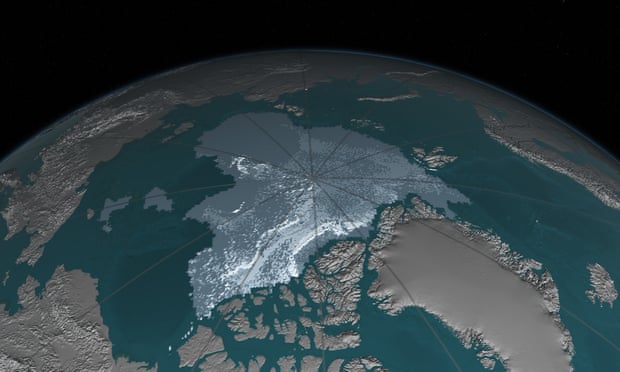
This paucity of sea ice bodes ill for the Arctic’s summer months when cover traditionally drops to its lower annual level, and could plunge to a record minimum this year. Most scientists expect that, at current emission rates, the Arctic will be reliably free of sea ice in summer by 2030.
By “free” they mean there will be less than 1million sq km of sea ice left in the Arctic, most of it packed into remote bays and channels, while the central Arctic Ocean over the north pole will be completely open. There will be much less than 1million sq km of ice by the year 2050. The first single ice-free year will come much earlier than this, however.
And when that happens, the consequences are likely to be severe for the human and animal inhabitants of the region. An ice-free Arctic will be wide open to commercial exploitation, for example. Already, mining, oil and tourism companies have revealed plans to begin operations – schemes that could put severe strain on indigenous communities’ way of life in the region.
Equally worrying is the likely impact on wildlife, says Stroeve. “Juvenile Arctic cod like to hang out under the sea ice. Polar bears hunt on sea ice, and seals give birth on it. We have no idea what will happen when that lot disappears. In addition, there is the problem of increasing numbers of warm spells during which rain falls instead of snow. That rain then freezes on the ground and forms a hard ice coating that prevents reindeer and caribou from finding food under the snow.”
Nor would the rest of the world be isolated. With less ice to reflect solar radiation back into space, the dark ocean waters of the high latitudes will warm and the Arctic will heat up even further.
“If you warm the Arctic you decrease the temperature difference between the poles and the mid-latitudes, and that affects the polar vortex, the winds that blow between the mid latitudes and the high latitudes,” says Henry Burgess, head of the Arctic office of the UK Natural Environment Research Council.
“Normally this process tends to keep the cold in the high north and milder air in mid-latitudes but there is an increasing risk this will be disrupted as the temperature differential gets weaker. We may get more and more long, cold spells spilling down from the Arctic, longer and slower periods of Atlantic storms and equally warmer periods in the Arctic.
For her part, Stroeve puts it more bleakly: “We are carrying out a blind experiment on our planet whose outcome is almost impossible to guess.”
This point is backed by Desch. “Sea ice is disappearing from the Arctic – rapidly. The sorts of options we are proposing need to be researched and discussed now. If we are provocative and get people to think about this, that is good.
“The question is: do I think our project would work? Yes. I am confident it would. But we do need to put a realistic cost on these things. We cannot keep on just telling people, ‘Stop driving your car or it’s the end of the world’. We have to give them alternative options, though equally we need to price them.”
The Arctic ice cap reaches its maximum extent every March and then, over the next six months, dwindles. The trough is reached around mid-September at the end of the melting season. The ice growth cycle then restarts. According to meteorologists, the Arctic’s ice cover is now decreasing by 13% every decade – a direct consequence of heating triggered by increased levels of carbon dioxide in the atmosphere.
Climate change deniers claim this loss is matched by gains in sea ice around the Antarctic. It is not. Antarctic ice fluctuations are slight compared with the Arctic’s plummeting coverage.
Tuesday, February 7, 2017
Many of you will live to see him disappear from the earth

In spite of the dire predictions,
in the back of my mind, I can't help feeling a little spark of hope. Where would we be without hope??
Monday, February 6, 2017
More than 800 Earth scientists and energy experts (and counting) urge the Mr Trump to take six crucial steps

More than 800 Earth scientists and energy experts (and counting) urge the new president to take six crucial steps
President Trump has called climate change a Chinese hoax, vowed to dismantle America's climate and clean energy policies, and appointed climate deniers with ties to the fossil fuel industry to his transition team and Cabinet.
In response, more than 800 Earth science and energy experts in 46 states have signed an open letter to Donald Trump, urging him to take six key steps to address climate change to help protect “America’s economy, national security, and public health and safety.”
All signatories are pursuing or hold a PhD in relevant disciplines. All are either American or work in the United States.
The release of this open letter is accompanied by a public petition, which can be signed at Change.org.
To President Trump
We, the undersigned, urge you to take immediate and sustained action against human-caused climate change. We write as concerned individuals, united in recognizing that the science is unequivocal and America must respond.
Climate change threatens America’s economy, national security, and public health and safety1-4. Some communities are already experiencing its impacts, with low-income and minority groups disproportionately affected.
At this crucial juncture in human history, countries look to the United States to pick up the mantle of leadership: to take steps to strengthen, not weaken, this nation’s efforts to tackle this crisis. With the eyes of the world upon us, and amidst uncertainty and concern about how your administration will address this issue, we ask that you begin by taking the following steps upon taking office:
- Make America a clean energy leader. The vast majority of Americans - whether Republican, Democrat, or Independent - support renewable energy research and deployment5. Embrace the enormous economic opportunities of transitioning to an energy-efficient, low-carbon society6,7. Use part of your $1 trillion commitment to infrastructure development to expand democratized clean energy, boost U.S. competitiveness, and put America to work8. Since 2008, the cleantech industry has created one out of every 33 jobs in the United States. “Wind technician” is the fastest growing job category in America, and the solar industry has hired more veterans than any other sector9.
- Reduce carbon pollution and America’s dependence on fossil fuels. The majority of Americans are in favor of this5. Assure them that the policies helping to cut greenhouse gas emissions, curb air and water pollution, and accelerate clean energy growth, innovation, and jobs - such as the Clean Power Plan, renewable energy tax credits, and auto-efficiency standards - will stay in place. Continued funding and flexibility of federal agencies to address climate change, including the Environmental Protection Agency, the Department of Energy, and the National Aeronautics and Space Administration, are key to achieving these goals.
- Enhance America’s climate preparedness and resilience. In the past 5 years alone, storms, floods, droughts, and wildfires caused over $250 billion in damages10. As climate change continues to increase the frequency and severity of these extreme events, so too grows the burden on all taxpayers to pay for disaster relief and recovery3. Help protect and strengthen America’s communities, economy, and natural resources by investing in modern, climate-resilient energy, transport, building, and water infrastructure.
- Publicly acknowledge that climate change is a real, human-caused, and urgent threat. If not, you will become the only government leader in the world to deny climate science11. Your position will be at odds with virtually all climate scientists, most economists, military experts, fossil fuel companies and other business leaders, and the two-thirds of Americans worried about this issue1,2,12-15.
- Protect scientific integrity in policymaking. During your campaign, you said that your “administration will ensure that there will be [scientific] transparency and accountability without political bias16.” Uphold these standards by appointing scientific advisors, Cabinet members, and federal agency leaders who respect and rely on science-based decision-making. This would exclude many of your Cabinet and transition team appointees to date, who deny the scientific realities of human-caused climate change17,18.
- Uphold America's commitment to the Paris Climate Agreement. Reneging from this treaty - the product of 25 years of negotiations between almost every country on Earth - would undermine our best chance to avoid dangerous climate change. It would also poorly represent the American people, the majority of whom support US participation in the Paris Agreement19. The United States will lose its seat of influence at the international negotiating table, and will cede to China, the EU, and other countries its authority as a political, technological, and moral leader20.
Sincerely,
The signatures of eight hundred scientists were at the bottom of the letter. I trust you will take my word for it.
Saturday, February 4, 2017
Mr Trump ... Kiss my furry white ass

Want to ask a real expert if global warming is real?? Come fishing with me. We'll see how far you can swim before you drown.
And keep your little hands off my wife's pussy or I'll eat you.
Nanook.
Thursday, February 2, 2017
Fissure in Arizona is the largest of it's kind
The fissures in Arizona started showing up in 1929. They have been increasing in depth and size in recent years
because of the growing population mining the underground water in the state for human use and agriculture. When you remove the ground water in hot, dry areas, the surface, above ground, which is exposed to heat and dryness simply cracks apart from total lack of moisture, above and below. The residents of the state have become worried about this phenomenon. And so they have formed a committee of scientists to monitor these fissures. As they grow longer and deeper they become extreme hazards because they can open up anywhere.
Just imagine what fracking for natural gas might do in this state. Hydraulic fracturing of the shale rock below the surface uses millions of gallons of precious water and forces it, mixed with toxic chemicals into the ground to fracture the shale. The waste products are left to leach into water sources and sink holes and earthquakes are quite common.
Right now there is conflict in the Sahara desert in Algeria as the people in the area fight the oil companies to keep them from fracking. The fracking will destroy the little water they have and leave them with toxic waste which could destroy livestock and their fragile agriculture situation. Humans always seem to change the planet for worse not better.
Saturday, January 28, 2017
Subscribe to:
Posts (Atom)