Sunday, September 30, 2018

Killer whales in grave danger


killer whale orca

People really like killer whales — from the popularity of whale watching and movies like “Free Willy,” to the recent viral tale of a killer whale carrying its dead calf for over two weeks off the coast of Vancouver, British Columbia.
That makes the possible population collapse of these iconic creatures even more distressing.
A paper in the Sept. 28 issue of Science says killer whales are at great risk, but not from climate change, loss of habitat or loss of their prey. It will be due to something that sounds very 1970s – PCB, or polychlorinated biphenyl. Another harmful human invention.

Image result for images of killer whales


PCB Passed On Through Generations

PCBs are human-made chemicals used for making plastics, electronics, lubricants, heat transformers and other materials and technology. In the late 1970s, studies showed the harmful effects of PCB on humans and on wildlife, such as birds, otters and seals.
In 1979, the U.S. Environmental Protection Agency banned the chemicals. European agencies followed suit over the next decade.
But PCB is still being produced, and marine animals high on the food chain, like killer whales and sharks, are being harmed most by it. According to a 2017 paper, killer whale populations off the coast of the most industrialized parts of Europe are close to extinction.
PCB impairs the animals’ reproduction and immune system, and increases their cancer risk, says ecologist Jean-Pierre Desforges, co-author of the Science study.
In addition, PCBs are easily transmitted from mother to calf. “We are very worried about reproductive effects where these high levels of PCBs can impact the survival of killer whale offspring,” says Desforges, a postdoc at Aarhus University in Denmark.
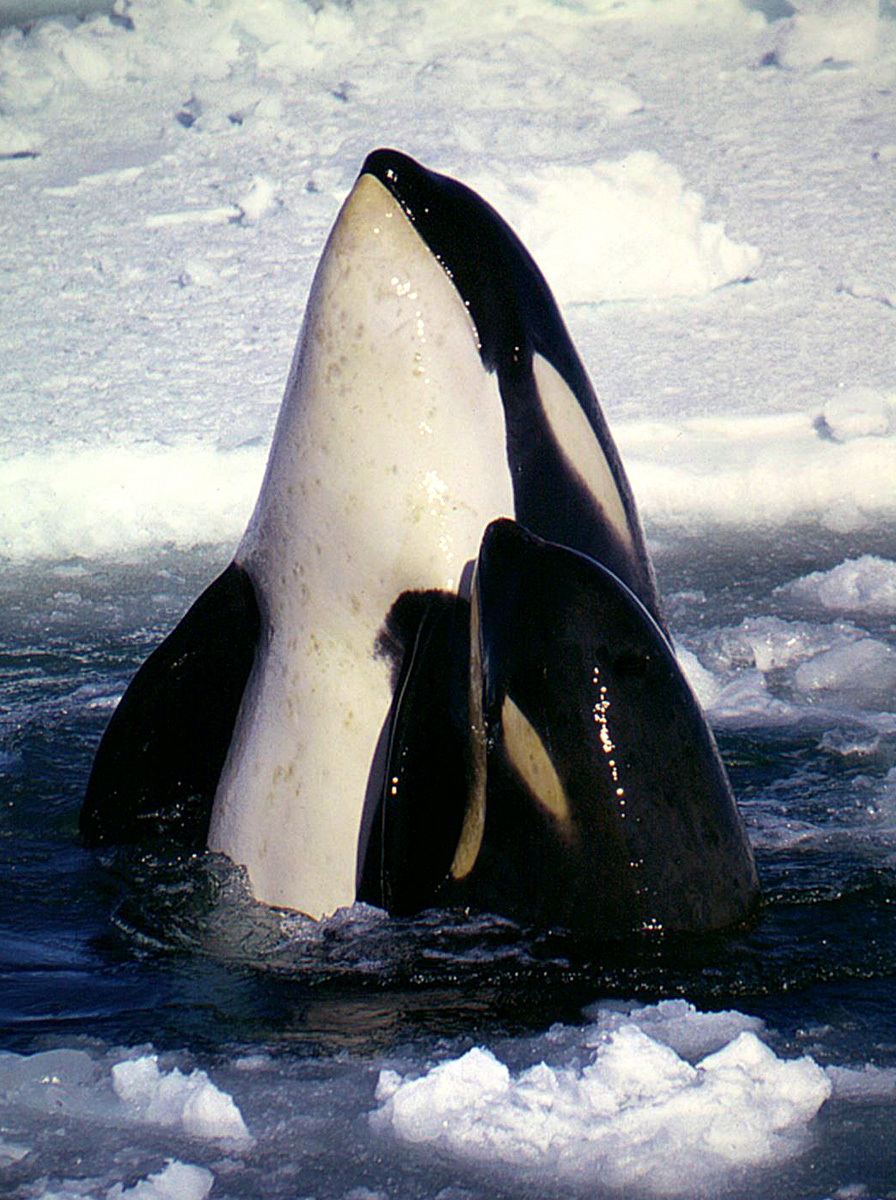

Súbor:Type C Orcas.jpg

Bleak Forecast for Some Whale Populations

Desforges and his team created a risk-assessment model to forecast the effects of PCB on killer whales over the next 100 years. It’s based on measurements of the chemicals in 351 killer whales from oceans around the world. The model simulates the chemical accumulation in whales and the level inherited by calves.
The North Pacific and North Atlantic oceans, which includes the coasts of Alaska, Iceland and Norway, have the lowest PCB risk. But the model suggests levels will continue to increase in those waters.
The highest risk is in parts of the Pacific and Atlantic oceans near Brazil, Hawaii, Japan, the Strait of Gibraltar and the United Kingdom, to name a few. These areas are near industrialized regions, where the chemicals were used a lot before being banned or, in some cases, are still being used.
Diet also impacts PCB concentrations in the animals. In the Northern Pacific, Bigg’s killer whales prey on marine mammals, tuna and sharks, and they have sky-high PCB levels, the paper says. This is probably because the larger prey carry more PCB and the chemicals are transferred to the predator. In the same Northern Pacific waters, killer whales preying on fish low in the food chain have lower PCB levels.

Killer Whales

Desforges says researchers need to study where PCBs are entering the environment, identify contaminated hotspots and clean them up. Also, more studies on the effects of the chemicals on killer whales are needed.
“Addressing the PCB issue will definitely not be straightforward because PCBs are so widespread and thus a global problem,” says Desforges.
This may be another species we will have to say goodbye to.


Related image

Saturday, September 29, 2018

Climate Change has created extreme weather events this year

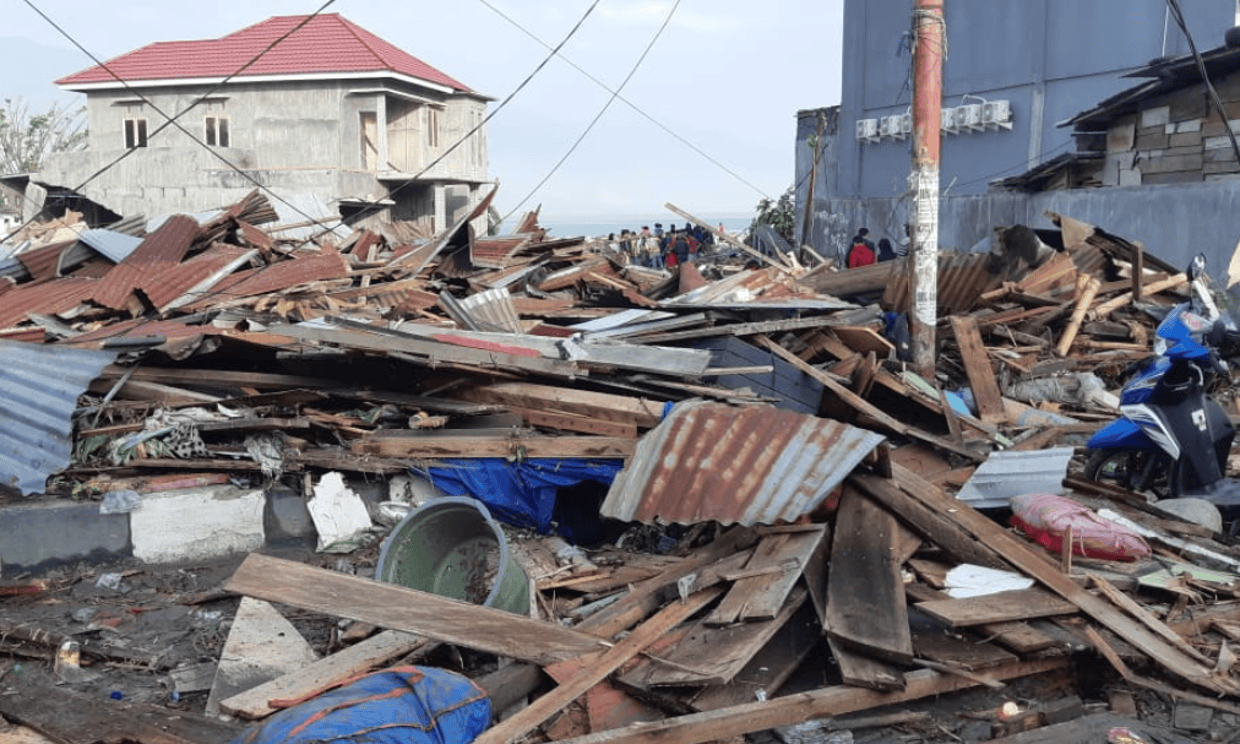
The scene in Palu, on the island of Sulawesi, Indonesia, after Friday’s tsunami.

Dozens are feared dead on the Indonesian island of Sulawesi after a powerful earthquake triggered a tsunami that swept away homes, buildings and bridges on Friday evening.
Rescuers have scrambled to reach hard-hit areas after a 1.5-metre (5ft) wave thundered over the coastline, crashing into Palu, the capital of central Sulawesi province, a smaller city in Donggala and several other coastal settlements, said Sutopo Purwo Nugroho, a spokesman for Indonesia’s disaster agency.
Indonesia’s Metro TV channel quoted one hospital official as saying at least 30 people had died but this has not been confirmed. Nugroho said in a television interview there are “many victims”, with families reported missing. However, communications and power supplies have been disrupted, hampering efforts to get information.
Dozens of injured people were being treated in makeshift medical tents set up outdoors, TV images showed.
Early witness reports said the tsunami had claimed lives on Talise beach in Palu, a city that is home to about 350,000 people. “Many corpses are scattered on the beach and floating on the surface of the sea,” Nining, a resident, said she had identified victims amongst the debris of the coastal area, which has reportedly sustained severe damage.
TV images showed dozens of injured people being treated in makeshift medical tents set up outdoors in public places.

Search and rescue teams have been sent to hard-hit areas, Nugroho said on Saturday. On Friday he said military transport planes and helicopters would be deployed on Saturday, along with “all national potential”.
“There are reports that many buildings collapsed in the earthquake,” he said. “Residents panicked and scattered out of their homes.”
            
The shallow 7.5 magnitude tremor was more powerful than a series of quakes that killed hundreds on the Indonesian island of Lombok in July and August.
People living hundreds of kilometres from the epicentre reported feeling the massive shake, hours after a smaller jolt killed at least one person in the same part of the south-east Asian archipelago.
Dramatic video footage filmed from the top floor of a parking ramp in Palu, nearly 80km (50 miles) from the quake’s epicentre, showed waves of water bring down several buildings and inundate a large mosque.


The magnitude 7.5 earthquake on Friday was followed by numerous strong aftershocks, including one of magnitude 6.7.

MORE EXTREME WEATHER:
Six tornadoes create havoc in Canada

See the source image

Last Friday six tornadoes touched down in Eastern Ontario. Gerald Cheng, a meteorologist, says that with the warm, humid temperatures, it was the perfect condition for a severe thunderstorm to develop.
 “Just because it’s hot and humid doesn’t mean there are thunderstorms, there has to be a trigger,” Cheng added. That trigger was the cold front that passed through. He added that with the winds going up in height and coming from different directions allowed for rotation, which caused the tornadoes. “Six touching down is extraordinary,” he said.
The last time there was a comparable event in Ontario was in 2009, Cheng said. That was when 18 tornadoes hit south of Toronto in the largest single-day tornado outbreak in Ontario and Canadian history.
“When thunderstorms do hit the area, you can seek shelter. That’s the first thing people should think about,” Cheng said. He added to always pay attention to Environment Canada alerts. He added that with the new alert ready system, it sends these alerts directly to your phone. It’s important, Cheng says, to take these alerts seriously.
Although Canada has been lucky in the past not to be troubled by many tornadoes, we are learning how to cope now that Climate change has visited extreme weather events upon us. The last decade has taught us some hard lessons: ice storms, wind storms, lightening storms, wildfires, floods
and now tornadoes. If it starts raining cats and dogs, I'm going to need a bigger umbrella.
 Love that global warming.

Saturday, September 22, 2018

By enforcing climate change denial, Trump puts us all in peril


Bob Richling carries Iris Darden as water from the Little River starts to seep into her home on Monday in Spring Lake, North Carolina. Flood waters from the cresting rivers inundated the area after the passing of Hurricane Florence. (Photo by Joe Raedle/Getty Images)
By  Jesse Jackson       09/17/2018 
North Carolina has been hit with a storm of biblical ferocity.

Florence has left at least 17 dead there, 500,000 without power, with flash flooding across the state from the coast to the western mountains. Landslides and infectious diseases are predicted to follow. North Carolina is not alone, of course.

We’ve witnessed the devastation wrought by Katrina in New Orleans, Hurricane Sandy in New Jersey, Hurricane Harvey in Houston and Hurricane Maria in Puerto Rico. Maria is now estimated to have taken 2,975 lives, nearly as many as died on Sept. 11, 2001.

As economics historian J. Bradford DeLong summarizes, the four storms — all in the past 15 years — are among the most damaging in U.S. history. No one storm can be attributed to any one cause. But repeated storms of greater force are the “predictable result” of catastrophic climate change, and they are a mild augury of what is likely to follow.

President Donald Trump has enforced climate denial in Washington. He has systematically sought to repeal even the inadequate steps the U.S. had taken to begin to address the problem. Last year he announced the U.S. was withdrawing from the Paris climate accord.

He’s geared up to repeal President Barack Obama’s executive orders on energy, climate and gas mileage. He’s opening up more public lands to mining and drilling and weakening environmental restrictions on coal, oil and natural gas, including most alarmingly, restrictions on the release of methane gas from natural gas pipes.

 Web pages with climate change information have been removed or buried at the EPA and the Interior and Energy departments. The rest of the world vows to continue to deal with climate change, but with the wealthiest nation in the world scorning the effort, it is certain to be more inadequate than it already is.

Catastrophic climate change is a clear and present threat to our national security. The Pentagon realizes this. It is developing contingency plans for bases around the globe that will be threatened by rising waters and raging storms. Its intelligence agencies warn that climate change will be more destabilizing than terrorism across the developing world.

DeLong offers one snapshot of the threat. Two billion poor farmers toil in the six great river valleys of Asia. Their existence is dependent on the snow melt from the region’s high plateaus arriving at the right moment and in the right volume to support the crops on which the billions rely. Another billion depend on the monsoon arriving at the right time each year.

Now as the planet heats up, the sea levels rise, the polar ice caps melt, so too the snow melt will change dramatically, as will the monsoons and cyclones. The disruption will wreak havoc on billions, forcing dramatic migrations to who knows where. The same is predicted as Africa gets hotter and drier, and desertification continues to uproot long settled peoples.

The effects are already here, visible in the scorching heat experienced across the country, the fires in the West, the drought in the South and the storms in the East. We are seeing climate change with our own eyes. Yes, no one storm or heat wave can be directly attributed to global warming. But global warming guarantees that catastrophic weather events will get more frequent and more ferocious.

Some suggest it is too late. The carbon already in the atmosphere will take us beyond the warming levels that the international community suggested were manageable. We are headed into the unmanageable.

But denial is no answer. Continuing to do more of the same is simple madness. It is not too late to make the wholesale cuts need in greenhouse gas emissions. Professor Michael Mann of Penn State University notes: “It is not going off a cliff; it is like walking out into a minefield. So the argument that it is too late to do something would be like saying: ‘I’m just going to keep walking.’ That would be absurd.”

Trump’s chaos presidency is corrosive and divisive. His impulsive and uninformed decision-making is terrifying. Now on what surely is becoming the greatest threat to our security — indeed human existence, if not addressed — he and the Republican Congress that aids and abets him, are adding fuel to the fire.


Without vision, the Bible says, the people perish. Trump’s blind denial of the reality around us seems intent on demonstrating how true that is.

Thanx Jesse
Knight Mama

Old Stone Drought Warning Resurfaces in Europe: 'When You See Me, Cry'

By Rafi Letzter, Staff Writer | August 27, 2018 
One of the "hunger stones" exposed by the low level of water in the Elbe river is seen in Decin, Czech Republic.Credit: Petr David Josek/AP/REX/Shutterstock 
Old stones bearing ominous messages have resurfaced in a river in Central Europe, according to news reports.
Over the course of centuries, Europeans marked low water levels during droughts by carving lines and dates into boulders along the Elbe River, which runs from the Czech Republic into Germany. The idea was that if water levels dipped low enough to reveal an old carving, it would signal to locals that dry, hungry times — similar to those experienced in the marked year — were coming. Over a dozen of these "hunger stones" have reappeared in the Elbe this year, amid a record-setting European drought, the Associated Press reported Aug. 23. [7 Surprising Health Effects of Drought]
And the stones' warnings aren't wrong. Agence France-Presse reported that northern Europe's current drought has not only brought with it record-setting temperatures and wildfires but also significant threats to local food production. In Sweden, Germany and the Netherlands, AFP reported, the grain harvest is expected to be down between 30 and 60 percent, depending on the region. England and France may also be significantly impacted. Farmers in northern Europe might have to "send much of their herds to slaughter due to a lack of feed," according to AFP.
While research indicates that climate change will exacerbate droughts in Europe — and make them more frequent around the world — these stones reveal how dangerous these sorts of events were when they occurred in previous centuries.
The oldest stone carving to emerge was carved in 1616 and is considered the oldest hydrologic landmark in Central Europe, according to the AP.
It "bears a chiseled inscription in German," the AP reported, "that says, 'when you see me, cry.'"
Originally published on Live Science
Thanx Rafi Leyzter
Crusader Jenny , Nanook & Mika